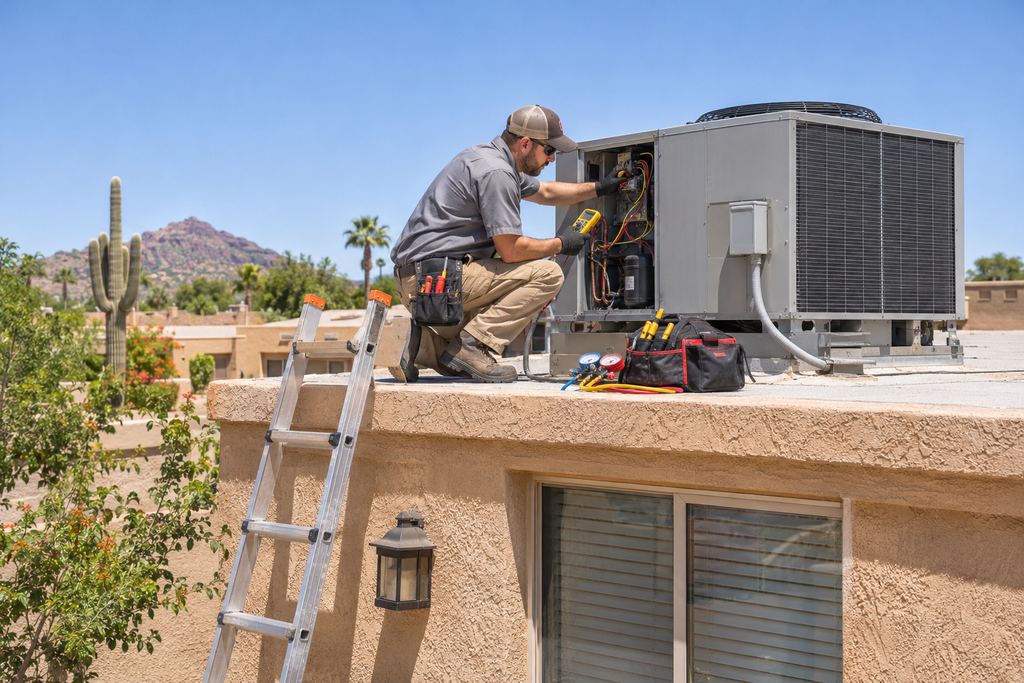
HVAC Repair in Phoenix
Most HVAC repair calls in Phoenix are about cooling, and most of them land between May and September, when an air conditioner may run for most of the day. This page covers what a Phoenix HVAC repair visit usually includes, what you can safely check first, and how to send a request to an independent local contractor.
Leave the building first
A gas smell is not a repair request. Stop here and do this now:
A carbon monoxide alarm is not a repair request. Stop here and do this now:
- Get everyone out of the house, pets too, and leave the door open behind you.
- Do not switch lights, appliances or the thermostat on or off, and do not use a lighter, a match or a phone inside.
- From outside, call your gas utility's emergency line or 911.
- Stay outside until the utility or the fire department says it is safe to go back in.
After the home is cleared, a licensed technician can check the furnace, boiler or water heater. You can come back to this form then.
Nothing was sent. This form does not handle gas or carbon monoxide emergencies.
Sending your request
Please keep this page open. The form is locked so the request is not sent twice.
Your request was received
We passed it to a contractor in your area. If one accepts, they contact you using the phone number or email you gave. We cannot say how soon, and you are not required to hire anyone.
No reply after a few days? Check your spam folder, then use the contact page.
We could not send your request
Nothing was sent to a contractor. Your answers are still on this page. Try again in a moment.Online requests are not connected yet
The request form is not linked to a contractor network yet. Nothing you typed was sent or saved. Please call instead, or try again later.Short answer
Turn the system off if you see ice, smell burning or hear grinding, check the thermostat, breaker and filter, then request a diagnosis. Availability varies by ZIP code and time of day, so ask about after-hours rates before you book.
What happens with a request in Phoenix
- You enter a ZIP code and the service you need.
- You add contact details and a short description.
- A contractor who accepts the ZIP code contacts you to arrange a visit. When depends on their schedule.
- You compare what you are told and any written estimate. You do not have to hire anyone.
No cooling during a Phoenix heat wave
Indoor temperatures climb fast in a closed house when it is over 105 degrees outside. Move people and pets to the coolest room, close blinds on the sun side, drink water, and check on older neighbors and relatives. Confusion, fainting, a very high body temperature or hot dry skin are signs of heat stroke: call 911. Maricopa County publishes cooling center locations each summer through its Heat Relief Network, and 211 can point you to one.
Why Phoenix systems fail the way they do
Long run hours do most of the damage. A condenser that sits on a roof or a west-facing slab in 115 degree air works near its design limit for weeks, and parts that wear with heat and cycling give out first: run capacitors, contactors, condenser fan motors and the compressor itself. Fine desert dust and monsoon storms add to it. Dust packs into condenser coils and filters, and summer lightning and power flickers can damage control boards.
Many Phoenix homes are single-story slab houses with the air handler or furnace in the attic or a garage closet, or with a rooftop package unit that holds everything in one cabinet. Attic and roof access in summer heat adds labor time, which is one reason two quotes for the same part can differ.
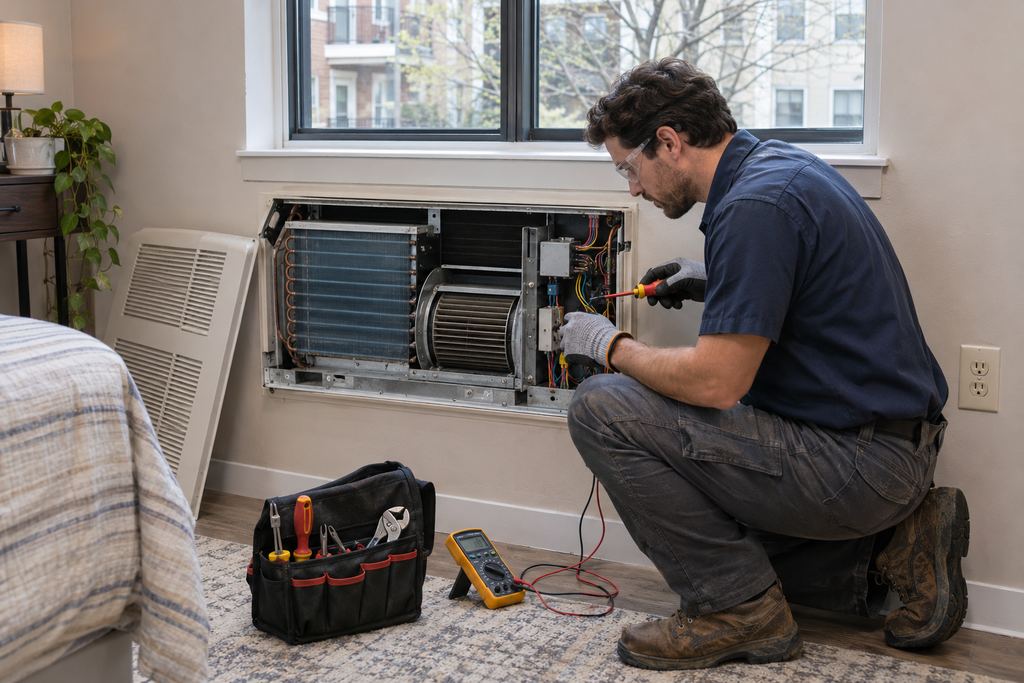
What a Phoenix HVAC repair visit usually covers
Exact scope depends on the company and the system. Ask what the diagnostic fee includes before the technician arrives.
- Cooling diagnosisElectrical tests on the capacitor, contactor and fan motors, refrigerant pressure readings, and a look at the condenser and evaporator coils.
- Airflow problemsBlower motor, filter, ductwork in the attic and blocked returns. Weak airflow is common in homes where ducts run through a very hot attic.
- Refrigerant leaksLeak search and repair by an EPA Section 608 certified technician. A recharge that skips the leak search tends to fail again within a season or two.
- Drain and float switchClearing a clogged condensate line, which can shut the system off through a safety float switch.
- Heating checksGas furnace ignition and flame sensor, heat pump reversing valve and defrost controls, ahead of the first cold nights in December.
- Thermostat and controlsWiring, settings and compatibility with the equipment, including smart thermostats.
System types you will find in Phoenix homes
- Split AC with gas furnaceOutdoor condenser plus an indoor furnace and coil. Common in larger and two-story homes.
- Heat pump split systemOne outdoor unit for both cooling and heating. The mild winter suits heat pumps, so they are widespread here.
- Rooftop package unitCooling and heating in one cabinet on a flat or low-slope roof. A gas pack adds a gas burner; a heat pump package is all electric.
Before you request a visit
Safe checks you can do
Only checks from the owner's manual that need no tools and no opening of panels.
- Thermostat on Cool, set a few degrees below room temperature, fresh batteries if it uses them
- Breakers for the air handler and the outdoor unit; reset a tripped one once only
- Air filter: replace it if it is gray or clogged with dust
- Outdoor unit clear of weeds, bags and stored items
- Ice on the lines or coil: switch cooling off and run the fan only until it thaws
- Condensate line and float switch visible and not overflowing
Leave these to a professional
Gas valves, burners, venting, refrigerant, capacitors and electrical circuits need a qualified, licensed technician.
- Capacitor, contactor and any panel on the unit (capacitors hold a charge with the power off)
- Refrigerant charge and leak repair
- Compressor and fan motor replacement
- Gas furnace burners, valves and venting
- A breaker that trips again right after a reset
Repair or replace in the Phoenix climate
There is no fixed rule. A system here racks up far more cooling hours per year than one in a mild climate, so age alone tells only part of the story. Bring these points to the conversation with the technician:
- Age and condition of the compressor and coils, not just the part that failed
- Refrigerant type: R-22 systems depend on reclaimed refrigerant since production and import ended in 2020, so recharges cost more
- The size of this repair compared with the cost of a new system, and how many repairs came before it
- Efficiency of the current unit and how high your summer bills run
Some people use the informal $5,000 rule of thumb: multiply the age of the unit by the repair cost, and if the result is over 5,000, look at replacement. It is a rough starting point, not a standard. Read more in the HVAC repair cost guide.
Questions to ask a Phoenix contractor
- 1What is the diagnostic or trip fee, and is it credited toward the repair?Fees vary between companies, and some are higher on evenings and weekends.
- 2Will you come out in the evening or on a weekend, and at what rate?Many companies are busiest in July and August. Ask for a realistic arrival window.
- 3Is the replacement part in stock?Common capacitors and contactors usually are. Compressors and some motors may need to be ordered.
- 4What is the license number?You can look up an Arizona contractor license with the Arizona Registrar of Contractors.
- 5Will I get the quote in writing before work starts?A written estimate should list parts, labor, refrigerant and any warranty.
Other Phoenix repair pages
HVAC repair in nearby cities
Only cities with a published page for this service.
Questions
Does an HVAC company fix air conditioning?
Yes. HVAC covers heating, ventilation and air conditioning, so an HVAC contractor repairs central AC, heat pumps and furnaces. In Phoenix most of their summer work is cooling repair. See AC repair for the general guide.
Do heat pumps work in Phoenix?
Yes. Phoenix winters are mild, so a heat pump rarely needs backup heat, and in summer it cools like a standard air conditioner. The trade-off is that it works year round, so the outdoor unit gets very little rest.
How long does an air conditioner last in Phoenix?
It depends on maintenance, installation quality and sun exposure. Because a Phoenix system runs far more hours each year than one in a mild climate, many local contractors see shorter service lives than national figures suggest. Ask the technician about the condition of the compressor and coils rather than relying on age alone.
What is the $5,000 rule for AC units?
It is an informal rule of thumb: unit age times repair cost. A result above 5,000 suggests looking at replacement. It ignores refrigerant type, efficiency and safety, so treat it as a conversation starter.
Can I get HVAC repair in Phoenix at night?
Some companies take after-hours calls, often at a higher rate. Availability depends on local contractors, your ZIP code and the season. This site cannot promise a visit time.