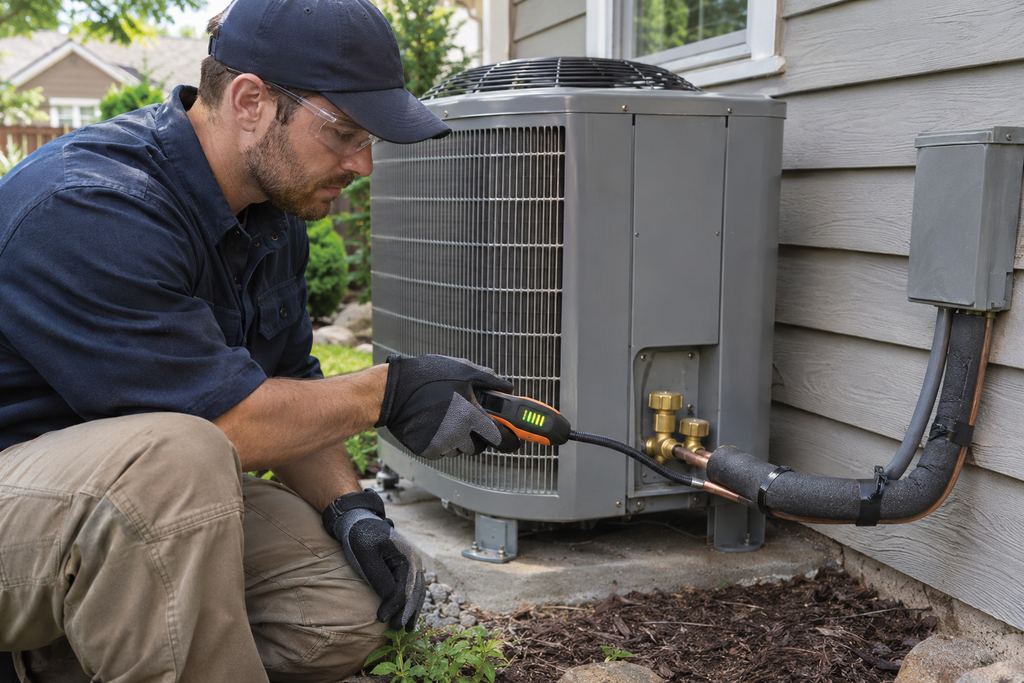
AC Refrigerant Leak Repair
AC refrigerant leak repair means finding where refrigerant escapes, repairing that spot and then charging the system to the maker's specification. Refrigerant circulates in a sealed loop and does not get used up, so a system that needs more has a leak somewhere.
Leave the building first
A gas smell is not a repair request. Stop here and do this now:
A carbon monoxide alarm is not a repair request. Stop here and do this now:
- Get everyone out of the house, pets too, and leave the door open behind you.
- Do not switch lights, appliances or the thermostat on or off, and do not use a lighter, a match or a phone inside.
- From outside, call your gas utility's emergency line or 911.
- Stay outside until the utility or the fire department says it is safe to go back in.
After the home is cleared, a licensed technician can check the furnace, boiler or water heater. You can come back to this form then.
Nothing was sent. This form does not handle gas or carbon monoxide emergencies.
Sending your request
Please keep this page open. The form is locked so the request is not sent twice.
Your request was received
We passed it to a contractor in your area. If one accepts, they contact you using the phone number or email you gave. We cannot say how soon, and you are not required to hire anyone.
No reply after a few days? Check your spam folder, then use the contact page.
We could not send your request
Nothing was sent to a contractor. Your answers are still on this page. Try again in a moment.Online requests are not connected yet
The request form is not linked to a contractor network yet. Nothing you typed was sent or saved. Please call instead, or try again later.Short answer
By law, only people with EPA Section 608 certification may open the refrigerant circuit. Ask any contractor whether they will locate and repair the leak or only top off; a recharge without a repair is a short-term fix.
Signs of a refrigerant leak
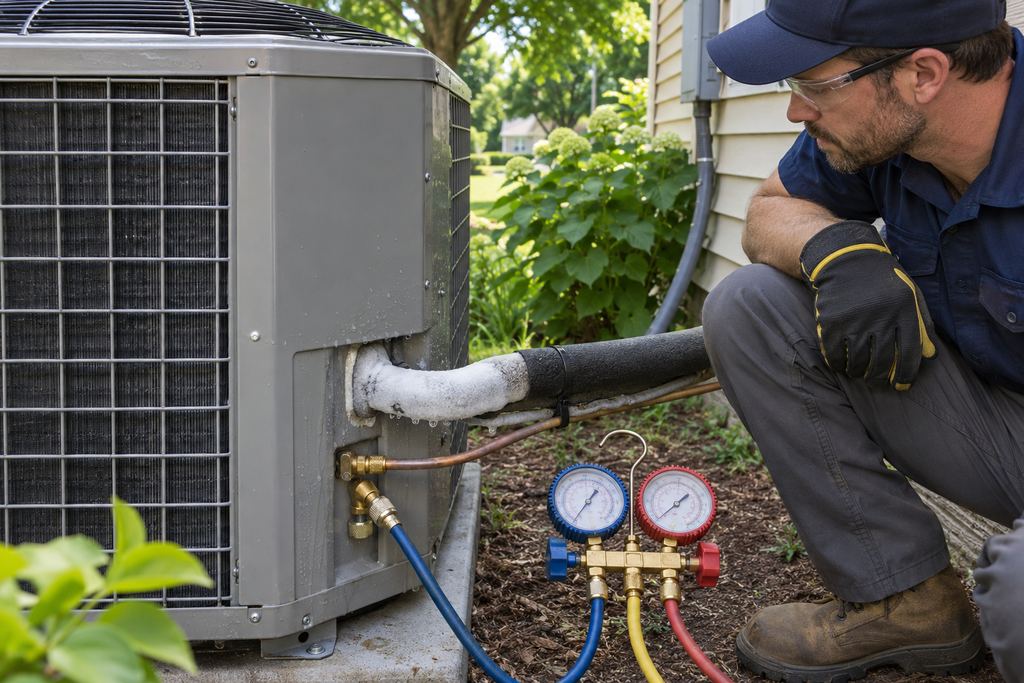
- Ice or frost on the larger copper line or indoor coilSwitch to fan only until the frost melts.
- Supply air feels cool rather than coldAnd it gets worse over weeks, not suddenly.
- Long run times and a higher power billThe system works harder to move less heat.
- Hissing or bubbling near the indoor or outdoor unitSmall leaks are usually silent, so absence of noise proves nothing.
- Oily residue on fittings or the coilRefrigerant carries oil, which collects at the leak.
- A recharge last year and the same problem nowThe clearest sign the leak was never fixed.
How leak repair works
- STEP 1Pressure and temperature readingsConfirm the system is undercharged rather than suffering from airflow or a dirty coil.
- STEP 2Leak searchElectronic detectors, bubble solution at joints, UV dye or a nitrogen pressure test isolate the leak. Coils and service valves are common spots.
- STEP 3RepairBrazing a joint, replacing a valve core or Schrader valve, or replacing a coil that has many pinhole leaks.
- STEP 4Evacuation and chargeThe system is pulled into a vacuum to remove moisture and air, then charged by weight or measured readings to the specification.
- STEP 5Follow-up checkSome contractors recheck pressures later to confirm the repair holds.
Your refrigerant type matters
Systems installed before about 2010 often use R-22. Its production and import ended in 2020 under EPA rules, so service relies on reclaimed and stockpiled supply and costs more per pound. Many current systems use R-410A, and newer equipment may use A2L refrigerants such as R-454B or R-32. A technician cannot mix refrigerants or put a different type into a system without following the manufacturer's conversion guidance.
If your unit is older and runs on R-22, ask for both a leak repair quote and a replacement quote before deciding. National leak repair and recharge figures are on AC refrigerant leak repair cost.
Do not use DIY recharge kits on a home system
How to choose a contractor for leak repair
- 1Will you locate and repair the leak, or only add refrigerant?A quote with no leak search is a recharge, not a repair.
- 2How do you search for leaks?Electronic detection, bubble test, dye or nitrogen pressure test.
- 3How many pounds will be added and at what price per pound?Especially important for R-22 systems.
- 4Who on the crew holds EPA Section 608 certification?The law requires it for anyone opening the refrigerant circuit.
- 5Is there a warranty on the repair?Ask what happens if the system loses charge again.
If cooling problems go beyond a leak
Low charge is one of several reasons for weak cooling. If you have not had a diagnosis yet, see AC repair or the symptom guide home AC not cooling. A compressor that ran hot for a long time on a low charge may also need attention; read AC compressor repair.
Questions about AC refrigerant service
Is a freon leak worth fixing?
Often yes on a newer system with one accessible leak, such as a valve or a single joint. On an older R-22 unit with a leaking coil, replacement may make more sense. Ask for both quotes in writing and compare them with the age and condition of the system.
Can I still run my AC if it's leaking refrigerant?
Running it low on charge can freeze the coil and overheat the compressor. If you see ice, switch to fan only. If cooling is just weaker than usual, run it sparingly until the visit.
Can I fix an AC refrigerant leak myself?
No. Opening the refrigerant circuit and buying or handling most refrigerants requires EPA Section 608 certification. Your role is to describe the symptoms and keep the system off if it ices.
Does AC refrigerant need to be topped off every year?
No. A sealed system should hold its charge for its life. Needing refrigerant every season means there is a leak to find.
How long does leak detection take?
A leak at an accessible fitting can be found during one visit. Small leaks in a coil can take longer and sometimes a second visit with a pressure test.