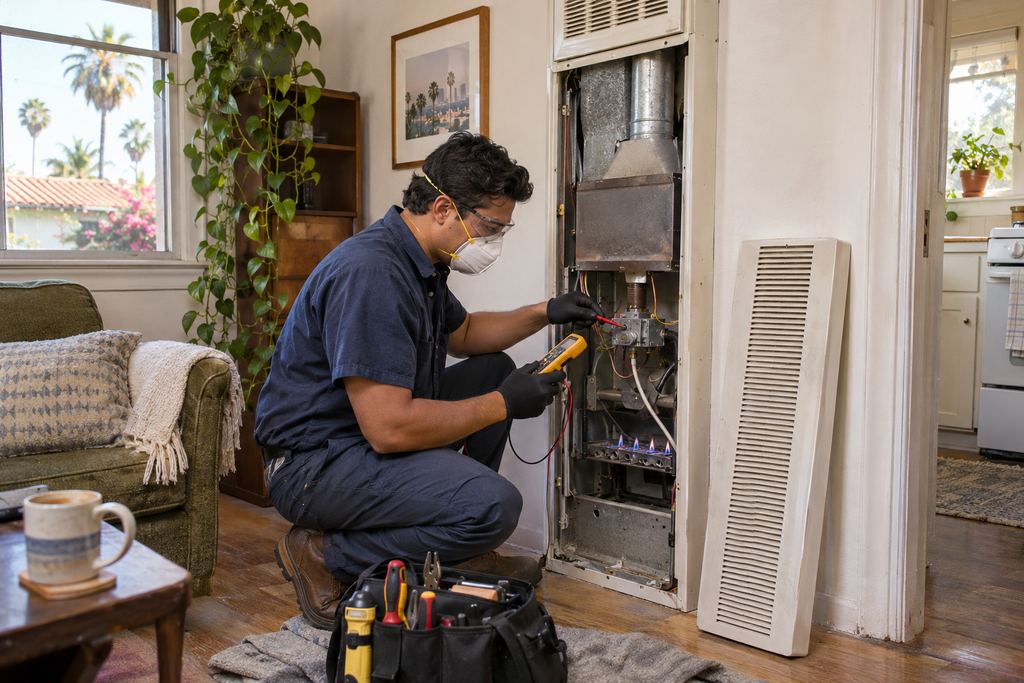
HVAC Repair in California
Choose your city below for the California repair pages that exist for it, or read the statewide California AC repair guide for rules that apply everywhere in the state. The form starts with your ZIP code, because whether a contractor can take the job depends on the address, not the city name.
Leave the building first
A gas smell is not a repair request. Stop here and do this now:
A carbon monoxide alarm is not a repair request. Stop here and do this now:
- Get everyone out of the house, pets too, and leave the door open behind you.
- Do not switch lights, appliances or the thermostat on or off, and do not use a lighter, a match or a phone inside.
- From outside, call your gas utility's emergency line or 911.
- Stay outside until the utility or the fire department says it is safe to go back in.
After the home is cleared, a licensed technician can check the furnace, boiler or water heater. You can come back to this form then.
Nothing was sent. This form does not handle gas or carbon monoxide emergencies.
Sending your request
Please keep this page open. The form is locked so the request is not sent twice.
Your request was received
We passed it to a contractor in your area. If one accepts, they contact you using the phone number or email you gave. We cannot say how soon, and you are not required to hire anyone.
No reply after a few days? Check your spam folder, then use the contact page.
We could not send your request
Nothing was sent to a contractor. Your answers are still on this page. Try again in a moment.Online requests are not connected yet
The request form is not linked to a contractor network yet. Nothing you typed was sent or saved. Please call instead, or try again later.Services and guides for California
California cities
Only cities with a published page are listed. The list grows as pages are approved.
One state, very different repair seasons
A furnace in Santa Rosa and an air conditioner in Bakersfield fail for different reasons. Central Valley cities such as Fresno, Modesto, Stockton and Sacramento see long stretches above 100 F, and cooling breakdowns cluster in July and August. Inland Southern California, from Riverside to San Bernardino and Fontana, adds Santa Ana winds that pack outdoor coils with dust.
Coastal cities like San Francisco, Long Beach and San Diego have mild summers. Many homes there have no central AC at all, so the calls are about wall furnaces, older boilers or a mini-split during a fall heat spell.
What tends to break where
| Region | Common equipment | When problems peak |
|---|---|---|
| Central Valley: Bakersfield, Fresno, Modesto, Stockton, Sacramento | Attic or garage furnaces with split AC, some rooftop package units | Summer heat waves; foggy winter mornings for furnaces |
| Inland Empire: Riverside, San Bernardino, Fontana | Slab homes with attic ducts and split systems | Summer heat and fall Santa Ana winds |
| Los Angeles and Orange County | Closet or attic furnaces with AC coils; wall and floor furnaces in older buildings | Late summer and fall heat; cool winter nights |
| Bay Area and North Bay: San Francisco, Oakland, San Jose, Santa Rosa | Gas wall heaters, older gravity and floor furnaces, apartment boilers, more heat pumps | September and October heat; winter heating |
| San Diego | Wall furnaces in older homes; split systems and heat pumps inland | August to October heat |
Rules that apply statewide
The Contractors State License Board (CSLB) licenses HVAC contractors in California, and warm-air heating, ventilating and air conditioning work falls under the C-20 classification. The CSLB website has a free license lookup.
Replacing a furnace, air conditioner or heat pump generally needs a permit under the state energy code (Title 24, Part 6), and some changeouts require duct leakage testing verified by a HERS rater. CARB rules phasing in from 2025 require new home air conditioning and heat pump equipment to use refrigerants with a global warming potential below 750, which is one reason newer units run on A2L refrigerants such as R-454B or R-32.
Power shutoffs are not breakdowns
Questions
Is a permit needed to replace an AC or furnace in California?
Generally yes. Title 24 requires a permit for most HVAC equipment changeouts, issued by the local building department. Ask whether the permit and any HERS verification are included in the estimate.
Is there help with heating and cooling bills in California?
The Department of Community Services and Development runs LIHEAP energy bill help through local agencies, and the large utilities offer the CARE rate discount to income-qualified customers. Dialing 211 connects you with local programs and cooling centers.
My city is not listed. Can I still send a request?
Yes. The form begins with your ZIP code. City pages are added only after they are written and reviewed, so a missing page tells you nothing about local contractors.