AC Repair
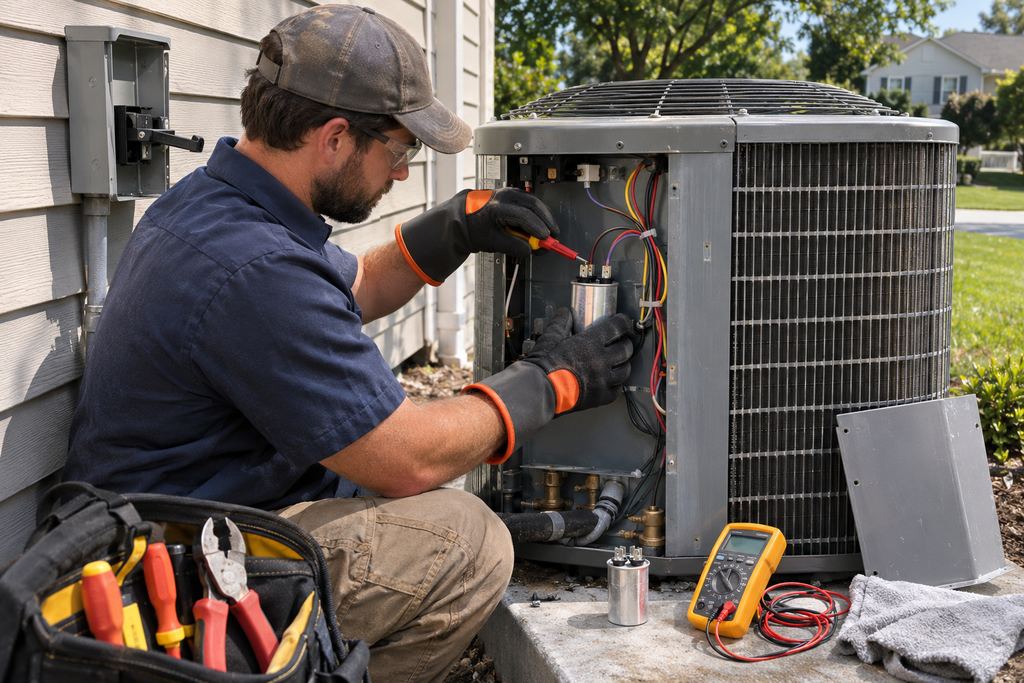
AC repair starts with a diagnosis at your home: a technician checks the thermostat signal, airflow, electrical parts and refrigerant circuit to find why the system is not cooling, then quotes the fix. Use the form to describe the problem and reach a local contractor; availability depends on your ZIP code and the time of day.
Leave the building first
A gas smell is not a repair request. Stop here and do this now:
A carbon monoxide alarm is not a repair request. Stop here and do this now:
- Get everyone out of the house, pets too, and leave the door open behind you.
- Do not switch lights, appliances or the thermostat on or off, and do not use a lighter, a match or a phone inside.
- From outside, call your gas utility's emergency line or 911.
- Stay outside until the utility or the fire department says it is safe to go back in.
After the home is cleared, a licensed technician can check the furnace, boiler or water heater. You can come back to this form then.
Nothing was sent. This form does not handle gas or carbon monoxide emergencies.
Sending your request
Please keep this page open. The form is locked so the request is not sent twice.
Your request was received
We passed it to a contractor in your area. If one accepts, they contact you using the phone number or email you gave. We cannot say how soon, and you are not required to hire anyone.
No reply after a few days? Check your spam folder, then use the contact page.
We could not send your request
Nothing was sent to a contractor. Your answers are still on this page. Try again in a moment.Online requests are not connected yet
The request form is not linked to a contractor network yet. Nothing you typed was sent or saved. Please call instead, or try again later.Short answer
Before a visit, check the thermostat mode, the filter, both breakers and the outdoor unit. If the system still will not cool, hums without the fan turning, ices up or trips the breaker, turn it off and request air conditioning repair.
What an AC repair visit usually covers
- DiagnosisThermostat call, voltage at the indoor and outdoor units, airflow, temperature drop across the coil and refrigerant readings where needed.
- Electrical repairsCapacitors, contactors, relays, fuses, control boards and damaged wiring.
- MotorsOutdoor condenser fan motors and indoor blower motors.
- Refrigerant circuitLeak search and repair, valve replacement, evacuation and recharge by an EPA Section 608 certified technician.
- DrainageClearing clogged condensate lines, replacing float switches and drain pans.
- Coils and airflowCleaning condenser and evaporator coils, fixing disconnected ducts near the unit.
Common AC faults and their clues
| What you notice | Frequent causes | Guide |
|---|---|---|
| Warm air from the vents | Outdoor fan or capacitor failure, frozen coil, low charge | Home AC blowing warm air |
| System will not start | Thermostat, breaker, float switch, control fuse | AC not turning on |
| Runs but the house stays hot | Dirty coils, leak, duct losses, undersizing | Home AC not cooling |
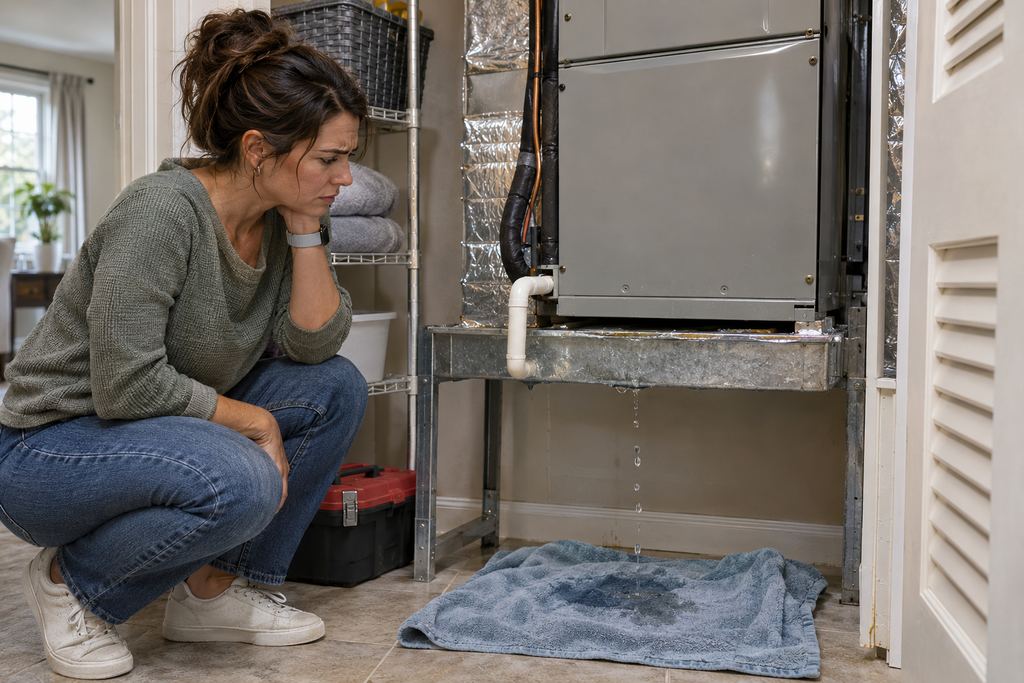
| Water at the indoor unit | Clogged drain line, cracked pan, frozen coil thawing | AC leaking water |
| Hum, clunk or breaker trip at start | Capacitor, contactor or compressor | Capacitor replacement |
Systems covered by AC repair
Most requests involve a central split system: an outdoor condenser connected by copper lines to a coil above a furnace or inside an air handler. Heat pumps share that layout and cool the same way, with a reversing valve that adds winter heating; see heat pump repair for their specific issues. Packaged units hold everything in one cabinet on a slab or roof. Ductless mini-splits pair an outdoor unit with one or more wall, ceiling or floor heads, and ductless AC repair often starts with fault codes the indoor head displays. Window units are usually replaced rather than repaired, and many HVAC companies do not service them.
When AC repair is urgent
People search for emergency AC repair when the house is getting dangerously hot. A broken AC becomes urgent when the indoor temperature is climbing during a heat wave and someone at home is older, an infant, pregnant, or has a heart, lung or other medical condition. It is also urgent if you smell burning, see smoke or the breaker trips repeatedly; in those cases turn the system off, and call the fire department for any smoke.
While you wait, move people to the coolest room or a cooled public building, keep everyone drinking water and use fans with a window open for ventilation. Call 911 for signs of heat stroke, such as confusion or fainting. Ask any contractor whether they take after-hours or weekend calls and what the after-hours rate is; this site cannot promise a visit at a given time.
What to ask an AC repair company
- 1How much is the trip charge, and does it come off the repair bill?Fees vary widely between companies.
- 2Do you charge more for evenings, weekends or holidays?Get the rate before you agree to the visit.
- 3Does your state require a license for this work, and can I see yours?Many states license HVAC contractors; you can check with the state board.
- 4Will I get a written quote before work begins?Ask for parts and labor listed separately.
- 5What warranty comes with the repair?Parts and labor warranties often differ.
- 6Does the technician hold EPA Section 608 certification?Required for any refrigerant work.
Repair or replace the air conditioner
A capacitor, contactor, fan motor or drain repair is usually worth doing on almost any system. The decision gets harder with a failed compressor, a leaking evaporator coil, or an older R-22 system, whose refrigerant has not been produced or imported since 2020. Weigh the system's age, the repair quote, refrigerant type, efficiency and how often it has failed. Some use the "$5,000 rule" (age multiplied by repair cost) as a rough screen, but it is informal. National price ranges are on AC repair cost.
Maintenance that prevents repeat calls
Change or clean the filter on schedule, keep two feet of clearance around the outdoor unit, and keep the condensate drain clear if your manual allows flushing it. A yearly tune-up before cooling season lets a technician clean coils, test capacitors and check refrigerant readings, which catches many of the faults that cause mid-summer breakdowns. ENERGY STAR and the Department of Energy both recommend regular professional maintenance for central systems.
Local guides for hot-climate states, such as AC repair in Arizona and AC repair in Texas, are listed with the others under locations.
AC repair by city
Only cities that have a published page appear here. Enter your ZIP code to check coverage for your address.
- Akron
- Albuquerque
- Alexandria
- Amarillo
- Anaheim
- Ann Arbor
- Arlington
- Atlanta
- Augusta
- Austin
- Bakersfield
- Baltimore
- Baton Rouge
- Bellevue
- Billings
- Birmingham
- Boise
- Boston
- Bridgeport
- Brownsville
- Buffalo
- Burlington
- Cape Coral
- Cedar Rapids
- Chandler
- Charlotte
- Chattanooga
- Chesapeake
- Chicago
- Cincinnati
- Cleveland
- Colorado Springs
- Columbia
- Columbus
- Corpus Christi
- Dallas
- Dayton
- Denver
- Des Moines
- Detroit
- Durham
- El Paso
- Eugene
- Evansville
- Fargo
- Fayetteville
- Fort Collins
- Fort Lauderdale
- Fort Wayne
- Fort Worth
- Frederick
- Fresno
- Frisco
- Gainesville
- Garland
- Gilbert
- Glendale
- Grand Rapids
- Greensboro
- Greenville
- Henderson
- Hialeah
- Honolulu
- Houston
- Huntsville
- Indianapolis
- Irvine
- Irving
- Jacksonville
- Knoxville
- Las Cruces
- Las Vegas
- Lexington
- Lincoln
- Little Rock
- Long Beach
- Los Angeles
- Louisville
- Lubbock
- Madison
- McKinney
- Memphis
- Mesa
- Miami
- Midland
- Milwaukee
- Minneapolis
- Mobile
- Modesto
- Montgomery
- Naperville
- Nashua
- Nashville
- New Haven
- New Orleans
- Newark
- Newport News
- Oakland
- Odessa
- Oklahoma City
- Omaha
- Orlando
- Overland Park
- Pensacola
- Philadelphia
- Phoenix
- Pittsburgh
- Plano
- Port St. Lucie
- Portland
- Provo
- Raleigh
- Rapid City
- Reno
- Richmond
- Riverside
- Rockford
- Sacramento
- Salem
- Salt Lake City
- San Antonio
- San Bernardino
- San Diego
- San Francisco
- San Jose
- Santa Ana
- Santa Rosa
- Sarasota
- Savannah
- Scottsdale
- Seattle
- Shreveport
- Sioux Falls
- Spokane
- St Petersburg
- St. Louis
- St. Paul
- Stockton
- Syracuse
- Tacoma
- Tallahassee
- Tampa
- Toledo
- Tucson
- Tulsa
- Virginia Beach
- Waco
- West Palm Beach
- West Valley City
- Wichita
- Wilmington
- Winston-Salem
- Worcester
Questions about AC repair
How do you repair an air conditioner?
A technician first confirms the thermostat is calling, then checks power at both units, airflow, the electrical start parts and refrigerant readings. The repair depends on the fault, from replacing a capacitor to fixing a leak. Homeowners should stop at the thermostat, filter, breaker and debris checks.
What is the job title of someone who fixes AC units?
An HVAC technician or HVAC service technician, sometimes an air conditioning or refrigeration mechanic. Anyone handling refrigerant needs EPA Section 608 certification, and many states also license the contractor.
How can you tell if your AC needs refrigerant?
Ice on the larger line, cool but not cold air and long run times are clues, but they also fit airflow problems. Only gauge readings show low charge, and low charge always means a leak to find.
How long does AC repair usually take?
Simple repairs such as a capacitor or contactor often take an hour or two once the technician is on site. Leak repairs, motor replacements and compressor work can take longer, and parts availability may add days.
Is emergency AC repair more expensive?
Often yes. Many companies charge a higher rate for evenings, weekends and holidays. Fixr's guide, updated January 2026, lists after-hours labor at about $150 to $300 per hour. Ask before you book.