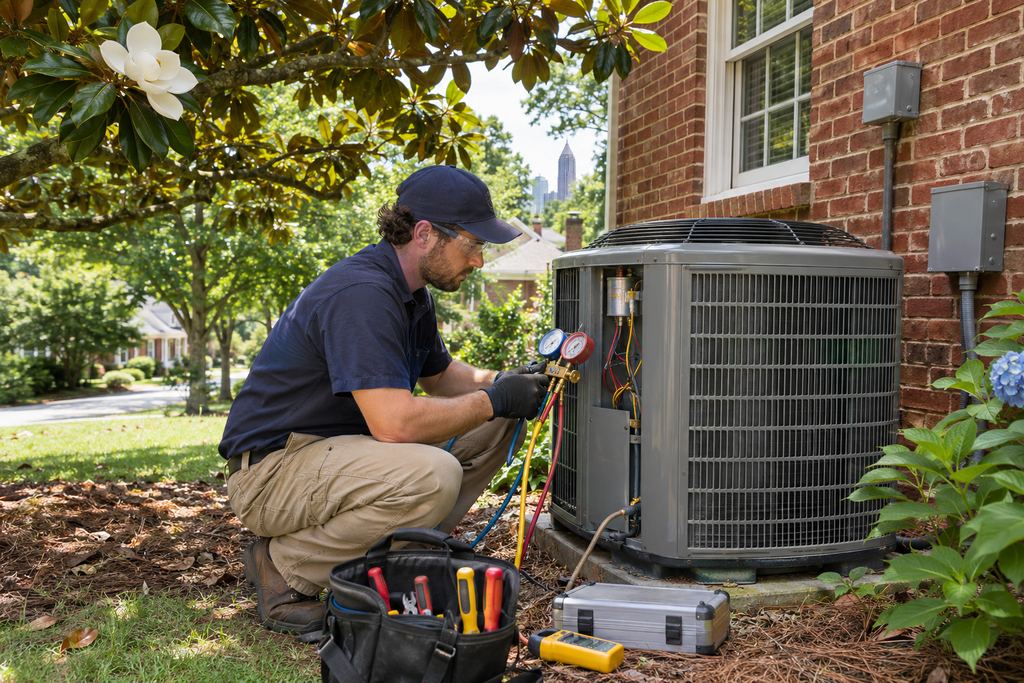
AC Repair in Miami
A Miami air conditioner that quits is a health problem as much as a comfort one, because the heat and humidity do not let up at night. Start with the few checks below, then use the form to reach a local contractor for AC repair in Miami who accepts your ZIP code.
Leave the building first
A gas smell is not a repair request. Stop here and do this now:
A carbon monoxide alarm is not a repair request. Stop here and do this now:
- Get everyone out of the house, pets too, and leave the door open behind you.
- Do not switch lights, appliances or the thermostat on or off, and do not use a lighter, a match or a phone inside.
- From outside, call your gas utility's emergency line or 911.
- Stay outside until the utility or the fire department says it is safe to go back in.
After the home is cleared, a licensed technician can check the furnace, boiler or water heater. You can come back to this form then.
Nothing was sent. This form does not handle gas or carbon monoxide emergencies.
Sending your request
Please keep this page open. The form is locked so the request is not sent twice.
Your request was received
We passed it to a contractor in your area. If one accepts, they contact you using the phone number or email you gave. We cannot say how soon, and you are not required to hire anyone.
No reply after a few days? Check your spam folder, then use the contact page.
We could not send your request
Nothing was sent to a contractor. Your answers are still on this page. Try again in a moment.Online requests are not connected yet
The request form is not linked to a contractor network yet. Nothing you typed was sent or saved. Please call instead, or try again later.Short answer
Check the thermostat, the breaker, the filter and the condensate drain switch first. If the system still will not cool, a technician needs to test the electrical parts and refrigerant circuit. Whether anyone can come tonight depends on the ZIP code and the hour.
What happens with a request in Miami
- You enter a ZIP code and the service you need.
- You add contact details and a short description.
- A contractor who accepts the ZIP code contacts you to arrange a visit. When depends on their schedule.
- You compare what you are told and any written estimate. You do not have to hire anyone.
If the house is getting dangerously hot
Move older adults, infants and anyone with a heart, lung or kidney condition to the coolest room, a relative's home or a public cooled space. Keep drinking water, use fans with a window cracked for airflow, and call 911 for confusion, fainting, a very high body temperature or hot, dry skin. Dial 211 to ask about cooling centers in Miami-Dade. A burning smell, smoke or a breaker that trips again right away means switch the system off and do not reset it.
Why Miami air conditioners fail the way they do
Most of the country runs its AC for a season. In Miami the compressor and blower work most months of the year, so wear that takes fifteen years elsewhere can show up sooner. Three local patterns come up again and again:
- Condensate problems. The air handler pulls a lot of water out of humid air. Algae and sludge grow in the drain line, the float switch trips, and the system shuts off or water spills from a closet or attic pan.
- Corrosion. Outdoor coils and electrical connections near the bay or the ocean take salt spray. Pitted fins, rusted cabinets and failing contactors are common on coastal units.
- Storm damage. Hurricane season runs from June 1 to November 30. Power surges, flooding of ground-level condensers and debris in the outdoor fan all cause late-summer repair calls.
Housing adds a fourth factor. Many condo apartments have an air handler in a hall closet and a condenser on a roof or mechanical floor, so the association may set rules for access, work hours and who can go on the roof. Single-family homes on slab often have the air handler in a garage, closet or attic.
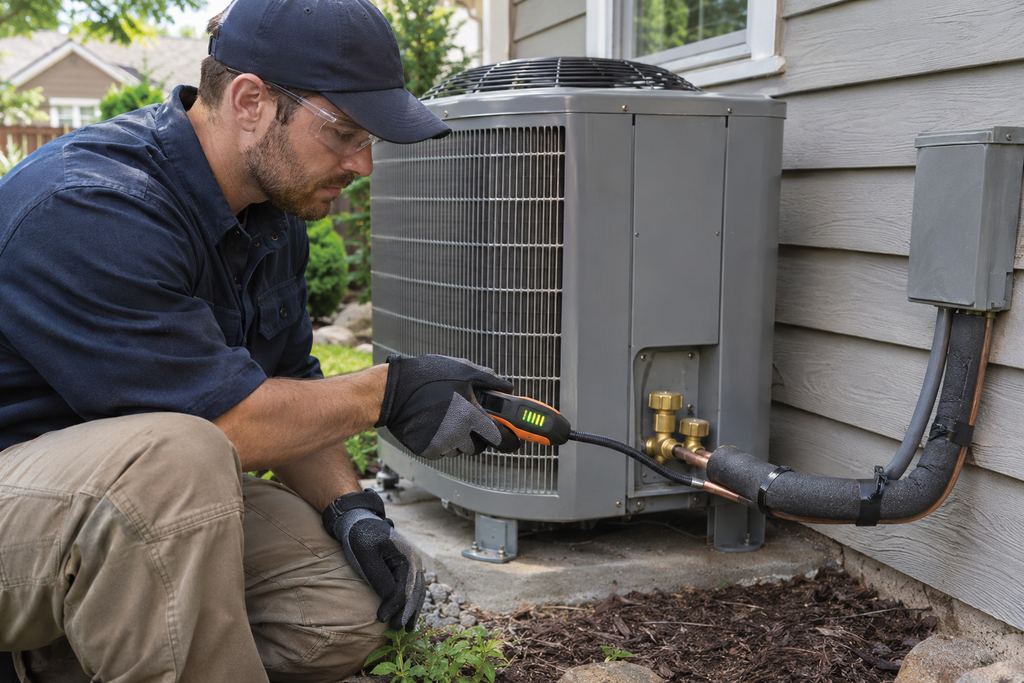
Your checks versus the technician's work
Safe checks you can do
Only checks from the owner's manual that need no tools and no opening of panels.
- Thermostat set to Cool, a setpoint a few degrees below room temperature, fresh batteries if it uses them.
- The AC breaker and the outdoor disconnect switch. Reset a tripped breaker once only.
- The air filter. A filter caked with dust can freeze the coil and stop airflow.
- The float switch or drain pan near the air handler. Standing water usually means a clogged drain line.
- Ice on the copper lines or indoor coil. Turn cooling off and run the fan only until it thaws.
- The outdoor unit: leaves, palm fronds or storm debris against the coil.
Leave these to a professional
Gas valves, burners, venting, refrigerant, capacitors and electrical circuits need a qualified, licensed technician.
- Testing capacitors, contactors and wiring. Capacitors hold a charge even with the power off.
- Measuring refrigerant pressure and finding leaks. Handling refrigerant requires EPA Section 608 certification.
- Clearing a deep drain blockage and checking the pan and safety switch.
- Checking the compressor, fan motors and control board after a surge or flood.
- Cleaning a corroded coil or quoting a coil or condenser replacement.
What changes the price of a Miami AC repair
We do not set prices, and a fair number depends on what the technician finds. These are the items that move a written estimate up or down.
Repair or replace in a hot, humid climate
No single rule decides this. The so-called $5,000 rule multiplies the system's age by the repair cost and suggests replacement when the result passes 5,000. It is an informal rule of thumb, nothing more. A better list of questions:
- How old is the system, and does it use R-22?
- Is the repair a small electrical part or a compressor or coil?
- Has the same leak been topped off before? Topping off a leaking system without locating the leak is a short-term fix.
- Is the outdoor coil badly corroded from salt air?
- Would a new, more efficient unit cut bills enough to matter, given how many hours a Miami system runs?
If the answer points to replacement, ask for a load calculation rather than a same-size swap. See the AC repair cost guide for national cost factors.
Upkeep that prevents the common Miami calls
- Filter every one to three monthsMore often with pets, construction dust or a system that runs nearly all year.
- Drain line attentionAsk the technician how to flush your drain line safely, if your equipment manual allows it, and how often.
- Rinse the outdoor coilA gentle hose rinse from the inside out, with power off at the disconnect, helps coastal units. Skip pressure washers.
- Before hurricane seasonHave the unit checked, clear the area around the condenser and ask about surge protection.
- After a floodDo not run an outdoor unit or air handler that sat in water until a technician inspects it.
Questions to ask a Miami contractor
Florida licenses air conditioning and mechanical contractors through the DBPR. You can look up a license by name or number at myfloridalicense.com.
- 1What is your Florida license number?Check that it is active and matches the company name on the estimate.
- 2What do you charge to come out, and at what hours?Get the diagnostic fee and any after-hours rate in writing.
- 3What exactly failed?Ask to see the part or a reading, and ask what else could cause the symptom.
- 4Is the price written and itemized?Parts, labor, refrigerant and permit should be separate lines.
- 5What warranty covers the work?Ask about the labor warranty and whether the part has a maker's warranty.
Other Miami pages
If the heat side or the whole system is the issue, see heat pump repair in Miami and HVAC repair in Miami. The Miami page collects all local guides, and the AC not cooling guide covers symptoms in more depth.
AC repair in nearby cities
Only cities with a published page for this service.
Questions
How long does AC repair usually take?
A simple part such as a capacitor or contactor is often replaced within the first visit if the technician carries it. Refrigerant leak searches, coil work or a compressor can take several visits because parts must be ordered. Ask for a time estimate after the diagnosis.
Is a 7 year old AC unit old?
Not by age alone. Many central systems last into their teens, but Miami units run many more hours a year than units up north, and coastal salt shortens coil life. Condition, refrigerant type and repair history matter more than the number.
What is the $5,000 rule for AC units?
It is an informal rule of thumb: multiply the unit's age by the repair quote, and if the result is above 5,000, consider replacement. It ignores refrigerant type, efficiency and condition, so treat it as a starting point for a conversation.
How expensive is it to fix an AC unit?
It ranges from a small part to a major component. Because we do not set prices, ask each contractor for an itemized written estimate after diagnosis. The AC repair cost guide lists the factors.
Can I get emergency AC repair in Miami at night?
Some local contractors take after-hours calls and some do not. Availability depends on the ZIP code and the time of day, and after-hours rates are usually higher. We cannot promise a same-night visit.