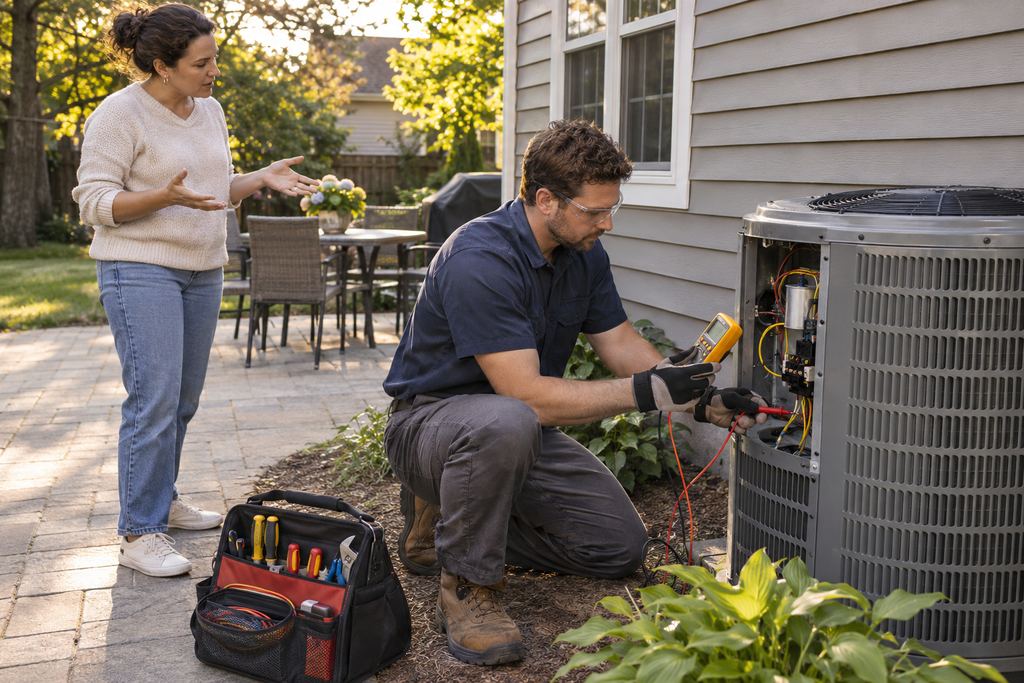
Emergency HVAC repair, starting with your ZIP code
Tell us what stopped working and where, and we pass your request for emergency HVAC repair to independent contractors who take jobs in your ZIP code. Smell gas or hear a carbon monoxide alarm? Leave the house and call for help from outside before anything else.
- AC, furnace, heat pump, boiler and thermostat problems
- Requests go to independent local contractors, not our staff
- Availability varies by ZIP code and time of day
- You read the quote and decide whether to book
Leave the building first
A gas smell is not a repair request. Stop here and do this now:
A carbon monoxide alarm is not a repair request. Stop here and do this now:
- Get everyone out of the house, pets too, and leave the door open behind you.
- Do not switch lights, appliances or the thermostat on or off, and do not use a lighter, a match or a phone inside.
- From outside, call your gas utility's emergency line or 911.
- Stay outside until the utility or the fire department says it is safe to go back in.
After the home is cleared, a licensed technician can check the furnace, boiler or water heater. You can come back to this form then.
Nothing was sent. This form does not handle gas or carbon monoxide emergencies.
Sending your request
Please keep this page open. The form is locked so the request is not sent twice.
Your request was received
We passed it to a contractor in your area. If one accepts, they contact you using the phone number or email you gave. We cannot say how soon, and you are not required to hire anyone.
No reply after a few days? Check your spam folder, then use the contact page.
We could not send your request
Nothing was sent to a contractor. Your answers are still on this page. Try again in a moment.Online requests are not connected yet
The request form is not linked to a contractor network yet. Nothing you typed was sent or saved. Please call instead, or try again later.Gas smell or CO alarm: get out first
- 1Gas smell or hissing near a gas lineDo not flip switches, use a phone or light anything inside. Leave, then call the gas utility's emergency number or 911 from outside.
- 2Carbon monoxide alarm or symptomsHeadache, dizziness or nausea, especially in several people or pets at once, means fresh air now. Get everyone outside and call 911 or the fire department. Even if the beeping stops, wait outside for the responders to clear the house.
- 3Smoke, sparks or a burning electrical smellTurn the system off at the thermostat and at the breaker if you can reach it safely. Call the fire department if you see smoke.
Which HVAC failures are urgent
Some breakdowns are uncomfortable. Others put people at risk. Treat these as urgent and say so when you describe the problem:
- No heat during freezing weather in a home with an infant, an older adult or someone with medical needs.
- No cooling during a heat wave, especially for older relatives, people on certain medications or anyone with heart or lung conditions.
- Water pooling near the furnace, air handler or any electrical part. Shut the power off at the breaker before you touch anything.
- A breaker that trips again as soon as you reset it.
While you wait for heat, gather people in one warm room, keep space heaters well clear of bedding and curtains, and never use a gas oven or grill to heat the house. Let faucets drip and open sink cabinet doors so pipes on outside walls stay warmer. Your local warming or cooling center can often be found by calling 211.
In a heat wave without AC, the first step is an air-conditioned place: a relative's home, a library or a cooling center that 211 can find. Fans are not a substitute once indoor air reaches 90°F, the CDC warns. Close blinds, open windows only if it is cooler outside, drink water and check on neighbors who live alone. Confusion, a very high body temperature or fainting are signs of heat illness: call 911 right away instead of waiting for a repair visit.
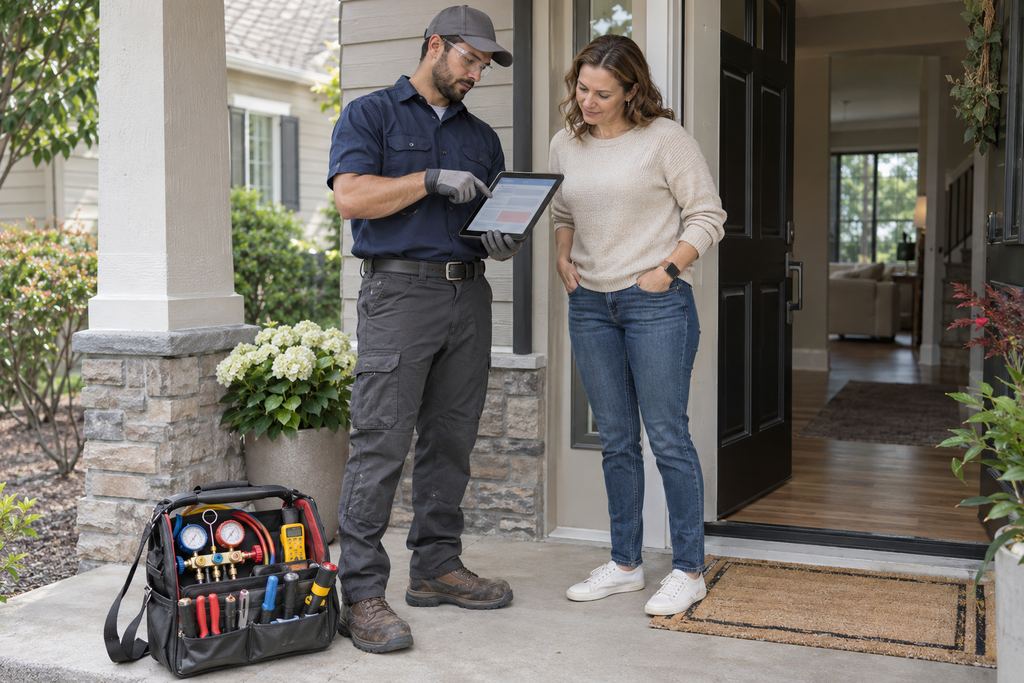
Five minutes of safe checks before you call
These are owner-level checks from most equipment manuals. They solve a surprising share of no-heat and no-cool calls, and they tell the technician what you already ruled out.
- ThermostatMode set to Heat or Cool, setpoint a few degrees past room temperature, fresh batteries if it uses them.
- Breaker and furnace switchReset a tripped HVAC breaker once. The furnace also has a light-style switch on or near it; make sure it is on.
- Air filterA filter packed with dust can starve the system of air and trigger safety shutdowns. Hold it up to a lamp; if no light passes, swap it.
- Furnace doorMany furnaces will not run unless the lower panel is seated firmly, because it presses a safety switch.
- Outdoor unit and drainClear leaves or covers from the condenser. A full condensate pan or a tripped float switch can shut cooling off.
- Ice on the lines or coilTurn cooling off and run only the fan so the ice melts. Running the AC frozen can damage the compressor.
Leave these to the technician
Repairs you can request here
Pick the closest match. If you are not sure what failed, choose a diagnosis in the form and describe what you see and hear.
System types and the calls they generate
Knowing your equipment type helps the contractor send the right person and parts. Each symptom has several possible causes; only an inspection narrows it down.
| System | Where it is common | Frequent repair calls |
|---|---|---|
| Central AC with a gas furnace | Most of the country | No cooling, frozen coil, failed fan motor, ignition faults in winter |
| Heat pump with air handler | Southeast, mild coastal areas, newer homes | Weak heat in cold snaps, defrost problems, refrigerant leaks |
| Hot water or steam boiler | Older homes in the Northeast and Midwest | Cold radiators, low pressure, circulator pump or zone valve faults |
| Ductless mini split | Additions, older homes without ducts | Error lights, dripping indoor heads, dirty filters and coils |
| Electric furnace or air handler | Mild climates, apartments, mobile homes | Tripped breakers, failed heating elements, blower trouble |
| Rooftop package unit | Small commercial buildings | Belt and motor wear, economizer faults, roof drain issues |
Start from the symptom
What happens after you send a request
- STEP 1Enter ZIP and systemTell us where the property is and which system has the problem, or choose to start with advice.
- STEP 2Describe the problemGive a name, a way to reach you and a short description of what the system is doing.
- STEP 3A contractor respondsA matched contractor reviews the request and contacts you. Timing varies by area and cannot be promised here.
- STEP 4Compare before you agreeAsk for the diagnosis and a written estimate. You are not required to hire anyone.
What an urgent repair bill depends on
We do not set prices, and contractors price differently. These are the parts of the bill worth asking about. Our HVAC repair cost guide covers each one in more detail.
- Trip or diagnostic feeMost companies charge to come out and find the fault. Ask whether that fee is credited toward the repair.
- After-hours, weekend and holiday ratesEvening and holiday calls often carry a higher rate. Ask for the number before the technician leaves the shop.
- Parts and availabilityA common capacitor or ignitor may be on the truck. A brand-specific control board or compressor may need to be ordered.
- Refrigerant typeR-22 production and import ended in 2020, so older systems rely on reclaimed supply and cost more to recharge. Newer units use R-410A or A2L refrigerants such as R-454B and R-32.
- AccessAttic air handlers, rooftop units and tight crawl spaces take longer to work on safely.
- Warranty statusA parts warranty from the manufacturer may cover the part but not the labor. Have the model and serial numbers ready.
Questions to ask the contractor on the phone
- 1Do you take after-hours or weekend calls in my area, and what is that rate?Availability depends on the company and the hour. A clear answer now avoids a surprise on the invoice.
- 2What is the diagnostic fee, and does it go toward the repair?Ask whether the fee changes at night or on a holiday.
- 3Can I see your state license number?Most states license HVAC or mechanical contractors. You can check the number on the state board's website.
- 4Will I get a written estimate before work starts?The estimate should list parts, labor and any refrigerant by type and amount.
- 5What warranty comes with the repair?Ask separately about parts and labor, and how long each lasts.
When a repair stops making sense
There is no fixed rule for repair versus replacement. Some contractors use the informal "$5,000 rule": multiply the system's age by the repair price, and if the result tops 5,000, they suggest pricing a replacement. Treat it as a rule of thumb, not a verdict.
The facts that matter more are the age of the equipment, whether it runs on R-22, how often it has failed in the last few years, how much your energy bills have climbed, and whether there is a safety issue. A cracked heat exchanger, for example, can only be confirmed by a technician's inspection, and it usually ends the furnace's service life. Ask for both numbers, repair and replace, in writing.
Maintenance and efficiency after the repair
Many emergency calls trace back to small things left too long: a clogged filter, a blocked condensate drain, a dirty outdoor coil, a weak capacitor. A yearly tune-up for cooling before summer and for heating before winter gives a technician the chance to catch those. Between visits, change filters on the schedule your system needs, keep two feet of clear space around the outdoor unit and pour nothing but what the manual allows into the drain line.
If replacement comes up, ask about efficiency. Federal minimums for new central air conditioners and heat pumps have been rated in SEER2 since 2023, and a higher rating usually means lower cooling costs in hot climates. ENERGY STAR and your electric or gas utility list current rebates; check them before you sign.
Local conditions change the repair
A cooling failure in Phoenix in July and a furnace lockout in Minneapolis in January are different jobs with different parts and different stakes. Humid Gulf Coast homes see more clogged condensate drains; older Northeast homes still run on boilers and radiators. Our locations pages cover climate, housing and licensing details state by state.
Where we can connect you
Coverage and timing depend on which contractors accept requests in your ZIP code. Enter yours above to check. These states have the most searches.
Questions about HVAC repair
More answers in the FAQWhat is HVAC repair service?
It is the diagnosis and repair of heating, ventilation and air conditioning equipment: furnaces, boilers, heat pumps, central and ductless AC, thermostats and the ducts and controls that connect them. A visit usually starts with a diagnostic check, then a written estimate for the repair.
Who should I call if my heater is not working?
If you smell gas, call the gas utility or 911 from outside first. Otherwise, after checking the thermostat, breaker and filter, call an HVAC contractor that services your type of heat. You can request heating repair help here with your ZIP code.
What maintenance is needed for an air conditioner?
Owners should change or clean the filter, keep the outdoor unit clear and watch the condensate drain. A yearly professional check usually covers coil cleaning, electrical connections, capacitor testing, refrigerant pressures and drain flushing.
What is the name for a person who fixes AC units?
An HVAC technician, sometimes called an HVAC mechanic or AC repair technician. Anyone who handles refrigerant needs EPA Section 608 certification, and most states also license the contracting company.
Is this site available 24 hours a day?
You can send a request online at any hour, but that does not mean a contractor will answer or arrive at night. Whether anyone takes after-hours calls depends on the companies in your ZIP code. We cannot promise a same-day visit.
Do emergency HVAC repairs cost more?
Often, yes. Many companies charge a higher rate for nights, weekends and holidays, and some charge a higher trip fee. Ask for the after-hours rate and diagnostic fee on the phone, before the visit.
Start with your ZIP code
Describe the problem, add your ZIP code and how to reach you. A local contractor who takes the request contacts you, and you decide whether to book.