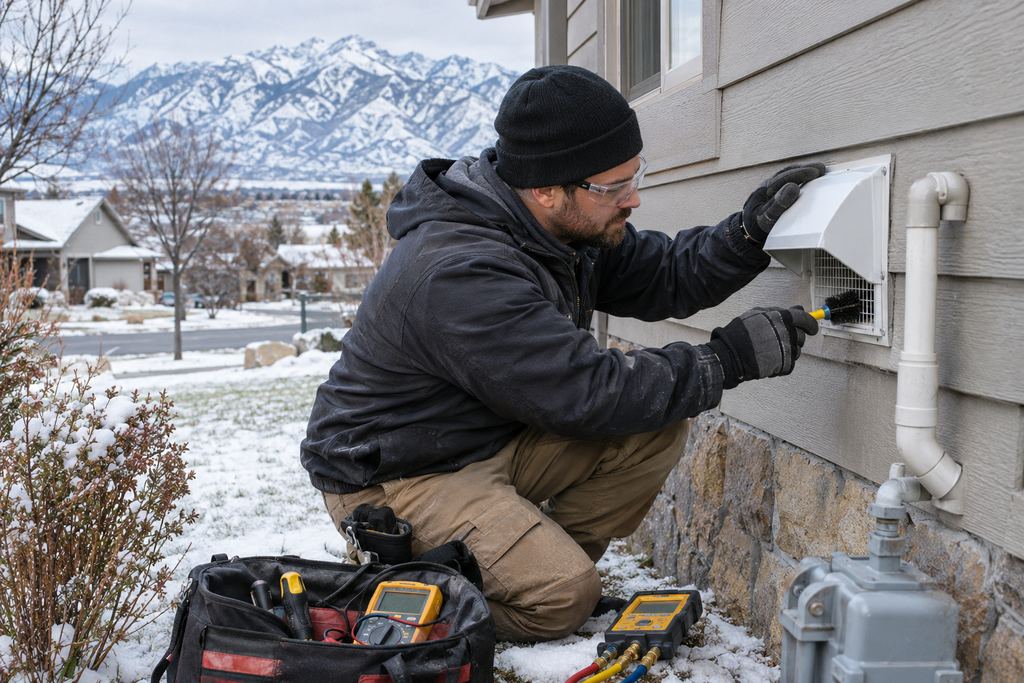
AC Repair in Salt Lake City, Utah
AC repair in Salt Lake City tends to arrive all at once: the first stretch of upper 90s in late June or July, when systems that idled since September have to run from noon to midnight. Describe what your air conditioner, heat pump or swamp cooler is doing and add your ZIP code, and the request goes to an independent air conditioning repair contractor in the Salt Lake Valley.
Leave the building first
A gas smell is not a repair request. Stop here and do this now:
A carbon monoxide alarm is not a repair request. Stop here and do this now:
- Get everyone out of the house, pets too, and leave the door open behind you.
- Do not switch lights, appliances or the thermostat on or off, and do not use a lighter, a match or a phone inside.
- From outside, call your gas utility's emergency line or 911.
- Stay outside until the utility or the fire department says it is safe to go back in.
After the home is cleared, a licensed technician can check the furnace, boiler or water heater. You can come back to this form then.
Nothing was sent. This form does not handle gas or carbon monoxide emergencies.
Sending your request
Please keep this page open. The form is locked so the request is not sent twice.
Your request was received
We passed it to a contractor in your area. If one accepts, they contact you using the phone number or email you gave. We cannot say how soon, and you are not required to hire anyone.
No reply after a few days? Check your spam folder, then use the contact page.
We could not send your request
Nothing was sent to a contractor. Your answers are still on this page. Try again in a moment.Online requests are not connected yet
The request form is not linked to a contractor network yet. Nothing you typed was sent or saved. Please call instead, or try again later.Short answer
Check the thermostat mode and batteries, the breaker, the filter and whether the outdoor fan spins. If there is ice on the lines, turn cooling off and run the fan. If the breaker trips again, the unit hums without starting, or it blows warm air with everything set correctly, request a technician.
When a broken AC becomes urgent
Why Salt Lake City AC systems fail the way they do
The city sits around 4,200 to 4,300 feet in a high desert valley. Summer days are hot and very dry, and nights usually cool off, so most homes need cooling for a shorter season than in Phoenix or Las Vegas but at full output once it arrives. Equipment that waited all winter meets its first real load in a single week, which is when weak capacitors, sticky contactors and tired condenser fan motors give out.
Several local patterns show up in repair calls:
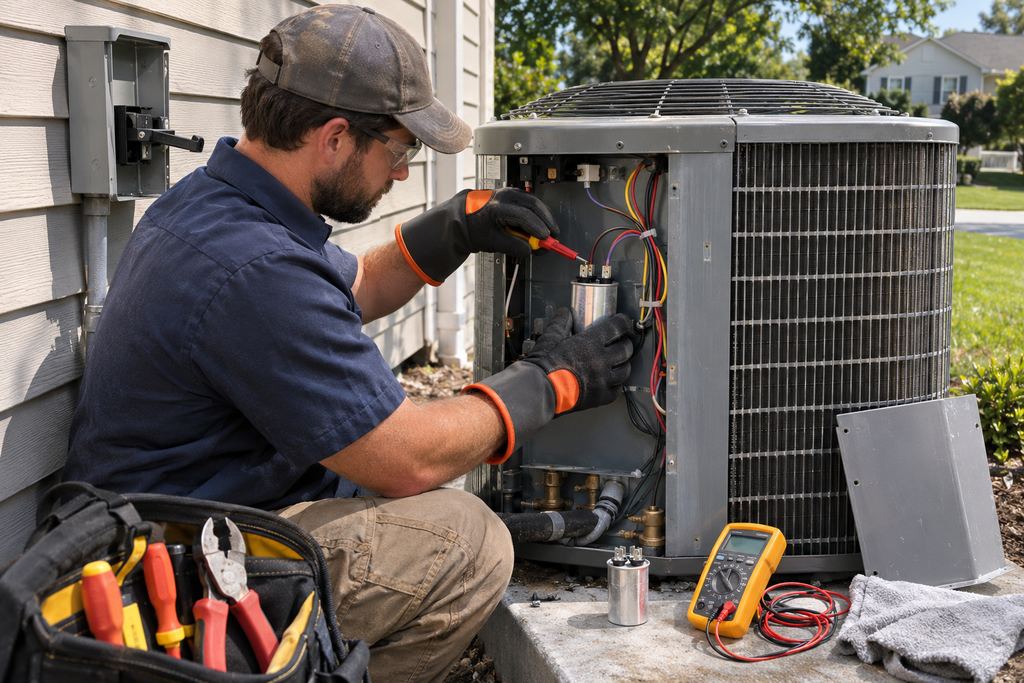
- Cottonwood seed and dust in early summer coat the outdoor coil and cut its ability to shed heat.
- Wildfire smoke from the region can load filters in days, starving the indoor coil of airflow until it ices.
- Many homes have the furnace and AC coil in the basement, so a condensate line or pump problem leaks onto a finished floor rather than a ceiling.
- Older homes near downtown and on the east bench often had central air added to ducts designed for heat only, which leaves upstairs rooms warm even when the equipment is healthy.
- Summer thunderstorms bring power blips that can damage control boards and compressors.
Cooling systems you will find in Salt Lake City
- Central split ACA condenser outside and a coil on top of the basement furnace. The most common setup in houses built since the 1970s.
- Evaporative coolerStill common on older homes because dry air makes them effective. Pads, pumps, belts and float valves wear, and the unit needs spring startup and fall winterizing.
- Heat pumpMore common in newer and all-electric homes, often paired with a gas furnace as backup. Faults can appear in both seasons.
- Ductless mini splitUsed in additions, basement apartments and older homes without ducts. Drain, sensor and board faults are typical.
- Window and through-wall unitsCommon in older apartments. Usually replaced rather than repaired.
- Rooftop package unitsFound on small commercial buildings and some multifamily properties; mention it in the request.
Common AC problems in Salt Lake City and what they can mean
Each symptom has several possible causes. Diagnosis is the technician's job; these are clues to include in your request.
| What you notice | Possible causes | Safe first step |
|---|---|---|
| Outdoor unit hums, fan does not spin | Capacitor, contactor, fan motor | Turn the system off; do not poke the fan |
| Blows air but not cold | Refrigerant leak, failed compressor start, dirty outdoor coil | Check thermostat and breaker, then request service |
| Ice on the copper lines or indoor coil | Clogged filter, weak blower, low charge | Cooling off, fan on until it thaws |
| Water on the basement floor | Clogged condensate line, failed pump, cracked pan | Shut power at the breaker if water is near wiring |
| Runs constantly, house will not cool | Undersized system, leaky ducts, low charge, dirty coil | Close blinds, replace the filter, request service |
| Short cycling | Oversized unit, thermostat placement, pressure or sensor faults | Note how long each cycle lasts |
| Breaker trips again after one reset | Shorted motor, compressor fault, wiring | Leave it off and request service |
| Swamp cooler blows warm, damp air | Dry pads, failed pump, float stuck, no water supply | Turn it off and check the water line valve |
| Loud buzzing or grinding | Contactor, fan bearings, debris | Turn it off and request service |
| Thermostat blank | Batteries, tripped float switch, blown control fuse | Replace batteries; check the float switch |
Troubleshooting you can do, and where to stop
Safe checks you can do
Only checks from the owner's manual that need no tools and no opening of panels.
- Thermostat set to Cool, a few degrees below room temperature, fan on Auto
- Fresh thermostat batteries
- Breaker for the outdoor unit and the furnace switch on; reset a tripped breaker once only
- Filter replaced, especially after smoke or dust days
- Two feet of clearance around the outdoor unit
- Condensate float switch not tripped and the drain line visible
- Swamp cooler: water supply valve open and pads wet
Leave these to a professional
Gas valves, burners, venting, refrigerant, capacitors and electrical circuits need a qualified, licensed technician.
- Anything behind electrical panels on either unit
- Capacitors, because they can still shock you after the power is cut
- Refrigerant work, which requires EPA Section 608 certification
- Compressor, fan motor and blower motor replacement
- Bypassing float, pressure or limit switches
- Control board and wiring repairs
What decides the price of AC repair here
We do not set prices, and no fair price exists before a diagnosis. The AC repair cost guide lists national factors; these move a Salt Lake City bill most.
Brands and warranties
Salt Lake City contractors work on the same major central AC and heat pump brands sold across the country, plus several evaporative cooler makes. We are an independent referral site with no affiliation with, or authorization from, any equipment maker. Before you approve an expensive part, find the model and serial number on the outdoor unit's rating plate and check with the manufacturer whether the unit was registered and what parts coverage remains. Some brands require registration within a set time after installation for the longest coverage, and a house sale can affect transfer. Your installer's paperwork may also list a separate labor warranty.
How a repair visit usually goes
- STEP 1You send the requestSymptom, system type, any codes or noises, and your ZIP code.
- STEP 2A contractor follows upAn independent company that covers your area contacts you if it can take the job. Ask about the fee and time window.
- STEP 3DiagnosisThe technician runs the system, takes electrical and refrigerant readings, and inspects coils, drain and airflow.
- STEP 4Written optionsThe failed part, the repair price and, for older equipment, sometimes a replacement quote too.
- STEP 5Repair and testAfter you approve, the repair is made and the system runs a full cycle while temperatures are checked.
How to vet a Salt Lake City AC contractor
Pick on facts you can check rather than ads or rankings.
- 1Is the company licensed in Utah?The Utah Division of Professional Licensing (DOPL) licenses contractors; search the company or license number.
- 2Will the person handling refrigerant hold EPA Section 608 certification?It is required for anyone who handles refrigerant.
- 3What is the diagnostic fee, and what are after-hours rates?Get both numbers before the visit.
- 4If the system is low on refrigerant, how will you find the leak?Adding refrigerant to a leaking system only buys time.
- 5Do you service my system type?Not every company works on swamp coolers or ductless units.
- 6How long is your labor warranty?Ask for it on the invoice.
Repair or replace: making the call
There is no fixed rule. Some contractors use an informal $5,000 rule of thumb: multiply the unit's age by the repair quote, and if the result is over 5,000, price a replacement as well. It is a prompt to compare, not a decision. Weigh these too:
- Age. A 7 year old AC is not old; many central systems last well past 15 years with maintenance. Near or past 20, a major repair is harder to justify.
- Which part failed. A capacitor or contactor is a routine repair at any age. A compressor or outdoor coil on an older system is where replacement quotes make sense.
- Refrigerant. An R-22 system that needs refrigerant faces rising costs because new R-22 is no longer produced.
- The furnace. In most Salt Lake City homes the AC coil sits on the furnace. If the furnace is also near the end of its life, replacing both together can save labor and let the new equipment be matched.
- Comfort problems. If the house never cooled well, a replacement is a chance to fix ducts and sizing, not just swap boxes.
Efficiency, sizing and swamp coolers
New central air conditioners and heat pumps are rated in SEER2. A higher rating uses less electricity for the same cooling, which matters more the longer your system runs. In dry Salt Lake City air, a well-maintained evaporative cooler uses far less electricity than central air, but it adds moisture, needs open windows for exhaust air, and struggles on muggy monsoon days in late summer. Some homeowners keep both.
Size matters as much as rating. An oversized AC cools in short bursts, cycles often and leaves rooms uneven; an undersized one runs nonstop on the hottest afternoons. A replacement should start with a load calculation (often called Manual J) based on your house, not the size on the old label. Ask your utility, Rocky Mountain Power for most of the city, whether any current incentives apply before you sign.
Maintenance that prevents most summer calls
- Spring checkup before JuneCoil cleaning, capacitor and motor readings, refrigerant pressures, drain flush and a thermostat check.
- Filters on a scheduleEvery one to three months, and right away after smoke days.
- Outdoor coilWith power off at the disconnect, rinse cottonwood and dust off gently from outside; do not bend fins.
- Condensate pumpIn finished basements, make sure the pump's discharge line is clear and the pump is plugged in.
- Swamp coolerNew pads and a cleaned reservoir in spring; drain and winterize in fall so lines do not freeze.
Other Salt Lake City pages
For winter heating see furnace repair in Salt Lake City. Heat pump owners can go to heat pump repair in Salt Lake City, and mixed problems fit Salt Lake City HVAC repair. The Salt Lake City hub lists every local page, and AC repair in Utah covers the rest of the state.
What happens with a request in Salt Lake City
- You enter a ZIP code and the service you need.
- You add contact details and a short description.
- A contractor who accepts the ZIP code contacts you to arrange a visit. When depends on their schedule.
- You compare what you are told and any written estimate. You do not have to hire anyone.
AC repair in nearby cities
Only cities with a published page for this service.
Questions
How much does it cost to repair a central air conditioner in Salt Lake City?
It depends on the part, refrigerant and timing. Capacitor or contactor repairs are at the low end; compressors and coils are major expenses. Ask for a written quote after the diagnosis and compare it with the cost guide.
Is a 7 year old AC unit old?
No. A 7 year old central air conditioner is usually mid-life or younger, and it may still be under the manufacturer's parts warranty if registered. Repair is usually the sensible choice at that age.
What is the $5000 AC rule?
A rule of thumb some contractors use: age times repair cost. Above 5,000, consider a replacement quote. It leaves out efficiency, refrigerant and comfort, so use it as a starting point only.
Should I hire one of the biggest HVAC companies in the country?
We do not rank companies or brands. For your repair, a Utah license, EPA certification, insurance and a written quote tell you more than company size.
My AC iced over during a week of wildfire smoke. Why?
Smoke and ash clog the filter quickly, cutting airflow across the indoor coil until it ices. Turn cooling off, run the fan to thaw, replace the filter and request service if it returns.
Can I get AC repair on a weekend in Salt Lake City?
Some contractors work weekends or evenings at a higher rate. It depends on the company and demand, so ask when you are contacted.