AC Repair in Pittsburgh
For AC repair in Pittsburgh, check the thermostat, the breaker and the filter before you call, then give the contractor your ZIP code, the symptom and the age of the system. Air conditioning repair in Pittsburgh is mostly central AC added to homes built for heat only, so ducts and basement air handlers are part of the picture.
Leave the building first
A gas smell is not a repair request. Stop here and do this now:
A carbon monoxide alarm is not a repair request. Stop here and do this now:
- Get everyone out of the house, pets too, and leave the door open behind you.
- Do not switch lights, appliances or the thermostat on or off, and do not use a lighter, a match or a phone inside.
- From outside, call your gas utility's emergency line or 911.
- Stay outside until the utility or the fire department says it is safe to go back in.
After the home is cleared, a licensed technician can check the furnace, boiler or water heater. You can come back to this form then.
Nothing was sent. This form does not handle gas or carbon monoxide emergencies.
Sending your request
Please keep this page open. The form is locked so the request is not sent twice.
Your request was received
We passed it to a contractor in your area. If one accepts, they contact you using the phone number or email you gave. We cannot say how soon, and you are not required to hire anyone.
No reply after a few days? Check your spam folder, then use the contact page.
We could not send your request
Nothing was sent to a contractor. Your answers are still on this page. Try again in a moment.Online requests are not connected yet
The request form is not linked to a contractor network yet. Nothing you typed was sent or saved. Please call instead, or try again later.What happens with a request in Pittsburgh
- You enter a ZIP code and the service you need.
- You add contact details and a short description.
- A contractor who accepts the ZIP code contacts you to arrange a visit. When depends on their schedule.
- You compare what you are told and any written estimate. You do not have to hire anyone.
Cooling in a city built before AC
Pittsburgh summers are warm and humid, with highs in the 80s and some stretches near 90. Much of the housing is older, often built before 1940, on steep lots with the furnace in the basement. Central air in those homes usually means a condenser beside the house and an evaporator coil sitting on top of the basement furnace, pushing cool air up through ducts sized for heat. Upper floors run warmer, and a weak system shows it there first.
Hillside lots also put outdoor units in awkward spots: on a narrow side yard, a retaining wall ledge or a deck. Leaves, soil washing down the slope and dense summer growth can choke the coil. Keeping two feet clear around the unit is one of the simplest ways to avoid a mid-July call.
Troubleshooting you can do safely
Safe checks you can do
Only checks from the owner's manual that need no tools and no opening of panels.
- Thermostat set to Cool, setpoint lowered, batteries fresh
- Breaker and outdoor disconnect on; reset once
- Furnace filter replaced if dirty (the AC uses the furnace blower)
- Furnace door panel closed so the blower can run
- Ice on lines: cooling off and fan on until it thaws
Leave these to a professional
Gas valves, burners, venting, refrigerant, capacitors and electrical circuits need a qualified, licensed technician.
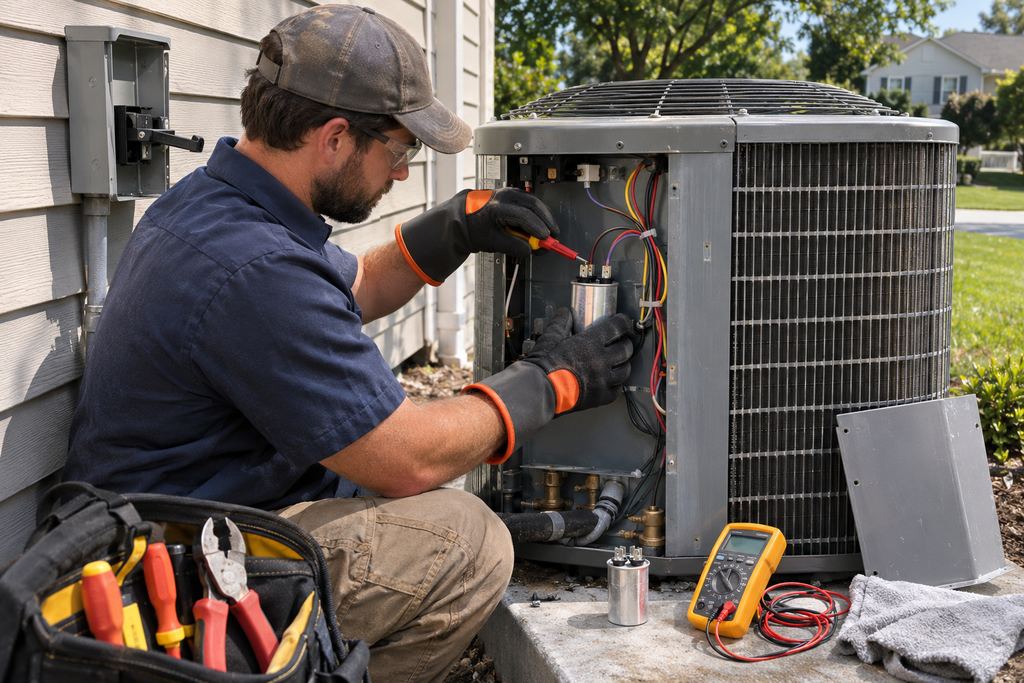
- Capacitor, contactor and condenser fan motor
- Refrigerant pressures and leak repair (EPA Section 608)
- Evaporator coil and drain pan service
- Compressor diagnosis
How a repair request works
- STEP 1Describe itWarm air, a quiet outdoor unit, ice, water by the furnace, or noise.
- STEP 2Check your ZIPCoverage changes from one ZIP code to the next and with the time you call.
- STEP 3Confirm the feeAsk for the diagnostic fee and any evening rate.
- STEP 4Diagnosis and written priceApprove the repair once you see the number.
What the visit covers
- Outdoor unit electrical testsCapacitors and contactors are frequent failures after the first heat.
- AirflowBlower, filter and coil; a dirty coil on top of the furnace is common in older basements.
- RefrigerantA leak search if charge is low. R-22 systems cost more to recharge since production ended in 2020; newer ones use R-410A or A2L refrigerants.
- DrainCondensate line and pump, which often run to a basement floor drain or laundry sink.
Systems Pittsburgh contractors repair
- Central AC on a gas furnaceThe most common setup. Furnace faults can stop cooling. See furnace repair in Pittsburgh.
- Heat pumpHeats and cools, often with a gas furnace backup. See heat pump repair in Pittsburgh.
- Ductless mini-splitUsed in homes heated by boilers and radiators that have no ducts.
What drives the price
We do not set prices; the AC repair cost guide explains the factors.
Questions for a Pittsburgh AC contractor
- 1What is your Pennsylvania HIC registration number?Pennsylvania has no statewide HVAC license; home improvement contractors register with the Attorney General, and you can search the number.
- 2Is the company insured?Ask for the certificate.
- 3How do you price the repair?Flat rate per job or time and parts; get it in writing.
Upkeep before June
- Spring tune-upBefore the first humid week.
- Filter changeEvery one to three months during the cooling season.
- Clear the slopePull weeds and leaves from around the condenser.
AC repair in nearby cities
Only cities with a published page for this service.
Questions
How long does AC repair usually take?
A capacitor or contactor swap is often done in one visit. Ordered parts, leak repairs and coil replacement take longer and may need a second trip.
Is a 7 year old AC unit old?
No. Seven years is mid-life for most central systems. Repairs are usually worth it at that age, especially if parts are under warranty.
What is the $5,000 AC rule?
Multiply the system's age by the repair cost; if the result passes 5,000, collect a replacement quote as well. It is informal, not an industry standard. Refrigerant type and efficiency also count.
Is HVAC the same as an AC system?
AC is one part of HVAC, which stands for heating, ventilation and air conditioning. In most Pittsburgh homes the AC shares the furnace blower and ducts. See HVAC repair in Pittsburgh.