HVAC Not Working
An HVAC not working can mean four different things: no heat, no cooling, no airflow, or a system that runs but cannot keep the house comfortable. Name the symptom first, then do only the checks that match it. That keeps you away from panels you should not open and gives the contractor a clear description.
Leave the building first
A gas smell is not a repair request. Stop here and do this now:
A carbon monoxide alarm is not a repair request. Stop here and do this now:
- Get everyone out of the house, pets too, and leave the door open behind you.
- Do not switch lights, appliances or the thermostat on or off, and do not use a lighter, a match or a phone inside.
- From outside, call your gas utility's emergency line or 911.
- Stay outside until the utility or the fire department says it is safe to go back in.
After the home is cleared, a licensed technician can check the furnace, boiler or water heater. You can come back to this form then.
Nothing was sent. This form does not handle gas or carbon monoxide emergencies.
Sending your request
Please keep this page open. The form is locked so the request is not sent twice.
Your request was received
We passed it to a contractor in your area. If one accepts, they contact you using the phone number or email you gave. We cannot say how soon, and you are not required to hire anyone.
No reply after a few days? Check your spam folder, then use the contact page.
We could not send your request
Nothing was sent to a contractor. Your answers are still on this page. Try again in a moment.Online requests are not connected yet
The request form is not linked to a contractor network yet. Nothing you typed was sent or saved. Please call instead, or try again later.Gas odor or CO alarm comes first
Short answer
Start with safety, then the thermostat, filter, breakers and service switch. A sudden stop is usually a tripped safety device, a power issue or a failed part such as a capacitor, ignitor or motor.
Match the symptom to the next step
| Symptom | First checks | Deeper guide |
|---|---|---|
| Nothing runs, thermostat blank or system silent | Thermostat batteries, breakers, service switch, blower door | HVAC not turning on |
| Fan runs, no heat | Thermostat on Heat, furnace filter, gas supply to other appliances | Heating not working |
| Fan runs, air not cold | Thermostat on Cool, filter, outdoor fan, ice on lines | Home AC not cooling |
| Outdoor unit runs, no air at vents | Filter, ice on the indoor coil | Turn cooling off and run fan only to thaw |
| Runs in short bursts | Filter, thermostat location, outdoor coil | AC short cycling |
| Water around the indoor unit | Power off at the breaker if water is near wiring, then drain pan and float switch | AC leaking water |
How to reset an HVAC system safely
A reset here means cutting and restoring power once so the control board starts fresh. Set the thermostat to Off. Turn off the service switch at the furnace or air handler and the breaker for the outdoor unit. Wait about five minutes. Turn the breakers and switch back on, then set the thermostat to Heat or Cool with the setpoint a few degrees past room temperature. Give it up to ten minutes, since many systems have start-up delays.
If it runs, watch it through one full cycle. If it fails again, stop. Repeated resets of a furnace in lockout or a breaker that keeps tripping can hide a fault that gets worse each time, and with gas equipment a repeated failed ignition is exactly what the lockout is there to prevent.
Why HVAC suddenly stops working
- A safety switch trippedHigh limit, rollout, pressure or condensate switches shut the system down to protect it. The trip is a symptom of something else, like a blocked filter or flue.
- A start component failedCapacitors, contactors, ignitors and flame sensors wear out and tend to fail at the start of a season when demand jumps.
- Power or control problemA tripped breaker, blown control fuse, failed transformer or damaged thermostat wire stops everything at once.
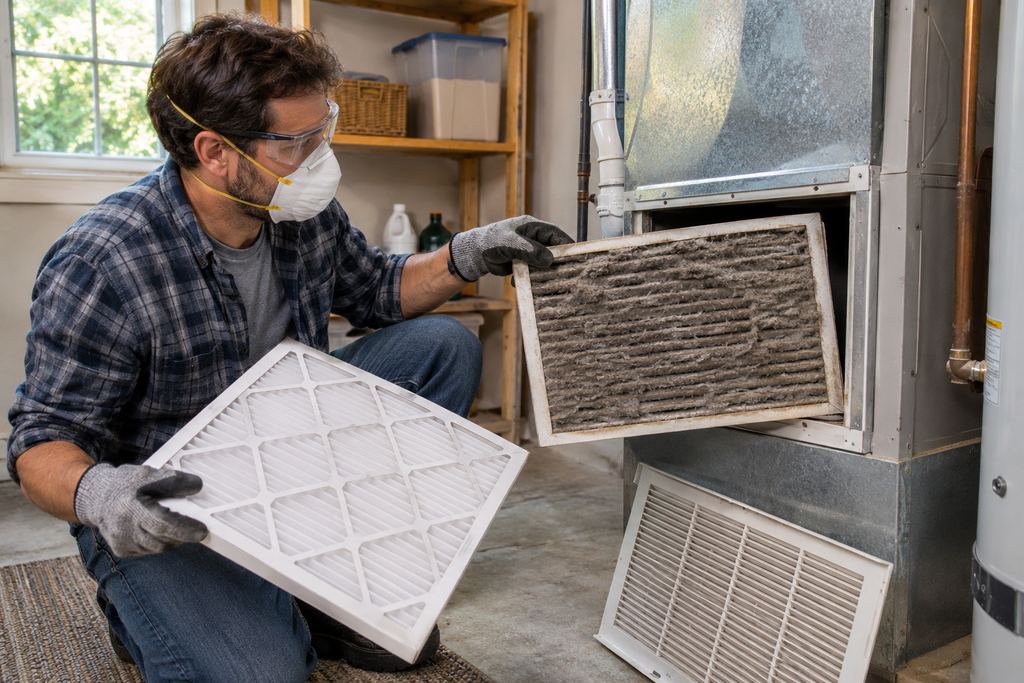
- Airflow blockedA clogged filter or frozen coil can cut airflow enough that the system overheats in winter or ices in summer.
What kind of system do you have?
Most US homes have one of these: a gas furnace with a central AC on top, an electric air handler with a heat pump outside, a boiler with radiators or baseboard and no ducts, or ductless mini-splits. A dual-fuel home pairs a heat pump with a gas furnace that takes over in deep cold.
The equipment label inside the door or on the outdoor unit gives the brand, model and often the manufacture date. Have it ready when you contact a contractor. Boiler owners can go straight to boiler not heating; heat pump owners to heat pump repair.
Repair or replace?
There is no fixed rule. A capacitor, ignitor or control fuse is a routine repair on almost any system. A failed compressor, cracked heat exchanger or leaking boiler on equipment past its expected service life is where the decision gets real. Weigh the age of the system, the quoted repair, the refrigerant it uses, how efficient it is compared with current equipment, and any safety findings.
Some people use the informal "$5,000 rule": multiply the system age by the repair cost and consider replacement if the result is over 5,000. It is only a rule of thumb. Ask for the repair quote in writing and, if replacement comes up, a separate written replacement quote. Typical repair fees are on HVAC repair cost.
Extreme weather with no system
Related services and guides
Pages that continue this topic.
Questions
How do I reset my HVAC system?
Set the thermostat to Off, switch off the service switch and the outdoor breaker, wait about five minutes, restore power and set the thermostat again. Do it once. If the system fails again, call a technician instead of repeating it.
Why would HVAC suddenly stop working?
Most sudden stops come from a tripped safety switch, a power or control fault, or a start component that failed. A clogged filter is behind more safety trips than people expect.
How do I fix my HVAC that is not heating?
Check that the thermostat is on Heat above room temperature, the filter is clean, the furnace switch is on and the blower door is seated. If other gas appliances work and the furnace still will not light, the ignitor, flame sensor or control board are common culprits for a technician to test. Do not relight anything after a gas smell.
What if the HVAC runs but no air comes out?
When you can hear the system but feel nothing at the registers, the blower motor, its capacitor or a frozen coil is the usual suspect. Turn cooling off and run the fan to see whether airflow returns as ice melts.
Is it safe to keep using a system that works some of the time?
It depends on the symptom. Intermittent cooling is usually safe to run while you wait. A furnace that rumbles, smells or trips its limit switch should be left off until it is inspected.