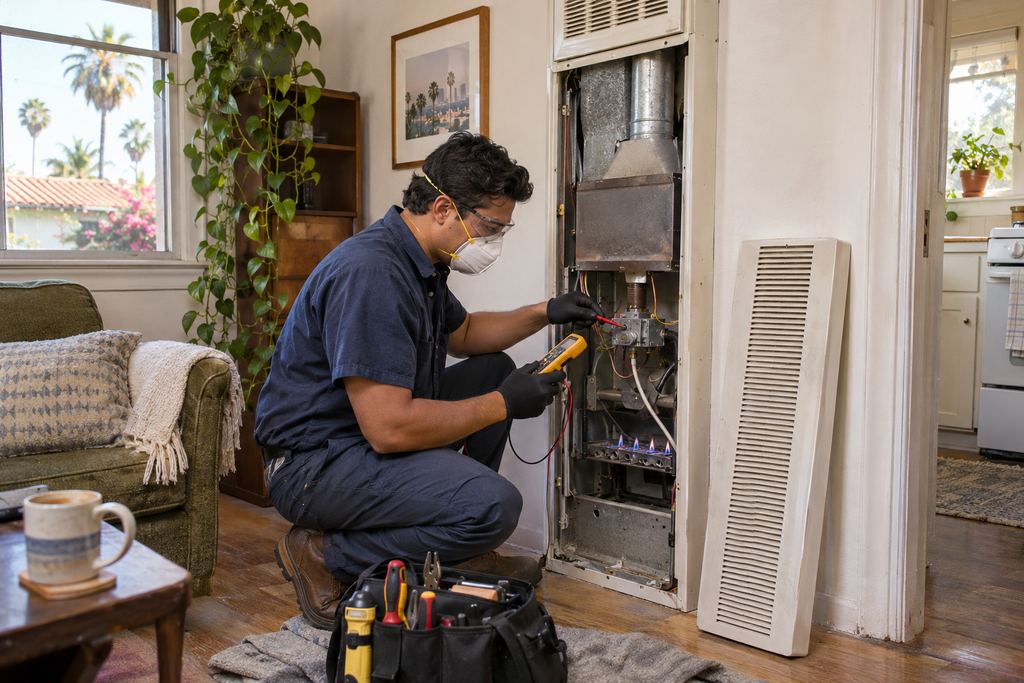
AC Repair in California
AC repair in California depends a lot on where you live. A Central Valley system may run hard for five months, while a coastal home may use cooling only during a few heat waves a year. This page covers the state-level points that apply everywhere: licensing, permits, refrigerant rules and cost factors, plus links to city pages.
Leave the building first
A gas smell is not a repair request. Stop here and do this now:
A carbon monoxide alarm is not a repair request. Stop here and do this now:
- Get everyone out of the house, pets too, and leave the door open behind you.
- Do not switch lights, appliances or the thermostat on or off, and do not use a lighter, a match or a phone inside.
- From outside, call your gas utility's emergency line or 911.
- Stay outside until the utility or the fire department says it is safe to go back in.
After the home is cleared, a licensed technician can check the furnace, boiler or water heater. You can come back to this form then.
Nothing was sent. This form does not handle gas or carbon monoxide emergencies.
Sending your request
Please keep this page open. The form is locked so the request is not sent twice.
Your request was received
We passed it to a contractor in your area. If one accepts, they contact you using the phone number or email you gave. We cannot say how soon, and you are not required to hire anyone.
No reply after a few days? Check your spam folder, then use the contact page.
We could not send your request
Nothing was sent to a contractor. Your answers are still on this page. Try again in a moment.Online requests are not connected yet
The request form is not linked to a contractor network yet. Nothing you typed was sent or saved. Please call instead, or try again later.Four California cooling patterns
The state's energy code divides California into 16 building climate zones. For AC repair, four broad patterns cover most homes.
- CoastalMild summers and many homes built without central air. Repairs spike during short heat waves, when demand for technicians jumps too.
- Inland Southern CaliforniaHot summers and Santa Ana wind events. Systems in the Inland Empire and inland Orange County run long hours from July to October.
- Central ValleyFresno, Bakersfield, Sacramento and Stockton see many days above 100 degrees, plus dust and poor summer air quality that load filters and coils.
- DesertsThe Coachella Valley and high desert push equipment near its design limits, with rooftop and ground units in full sun.
Heat, smoke and power shutoffs
During extreme heat, keep people in the coolest room, drink water and call 911 for heat illness signs; counties open cooling centers, and 211 can find one. When wildfire smoke is heavy, many owners run the AC with outdoor air closed and a higher-rated filter the system can accept. During a utility Public Safety Power Shutoff or a grid alert, the AC will not run on its own power, so plan a cool space ahead of time.
What AC repair covers in California homes
- Electrical diagnosisCapacitors, contactors, fan motors and control boards.
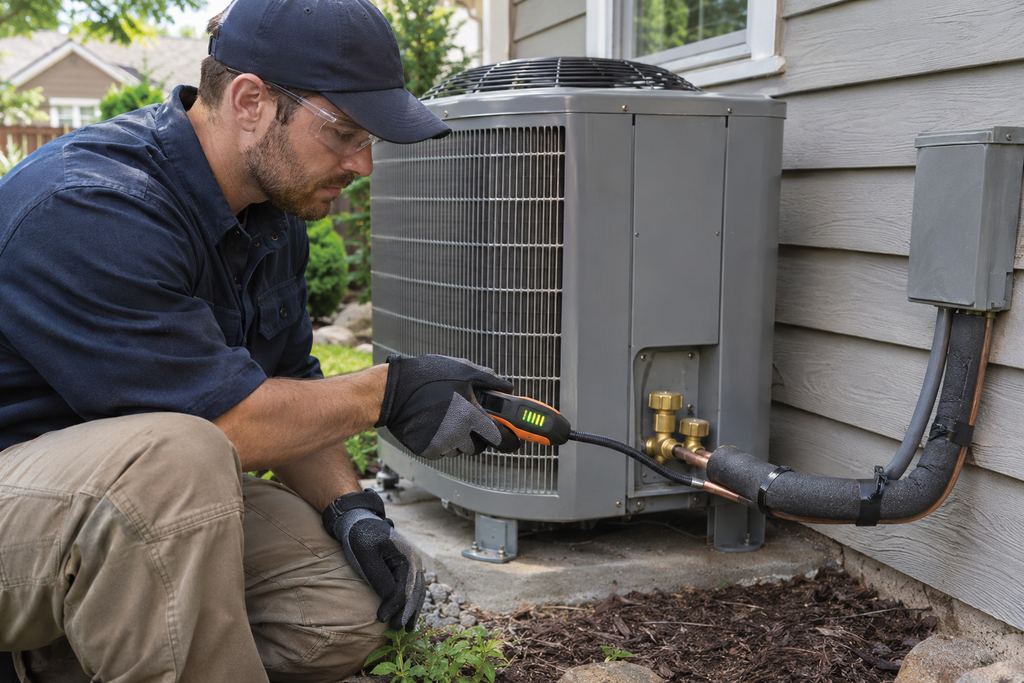
- Refrigerant leak repairOnly a technician holding EPA Section 608 certification may locate the leak and recharge.
- Frozen coils and airflowBlower motors, filters, and ducts in attics and crawl spaces.
- Condensate problemsDrain lines, pans, float switches and condensate pumps.
- Heat pump repairsReversing valves and defrost controls on systems that also heat.
- Thermostats and zoningWiring, settings and smart thermostat compatibility.
Owner checks and technician work
Safe checks you can do
Only checks from the owner's manual that need no tools and no opening of panels.
- Cool mode selected, with the setpoint a few degrees under what the room reads
- Breakers for the indoor and outdoor units; one reset only
- A clean filter, changed more often during smoke events
- Outdoor unit free of leaves, dust and stored items
- Ice on the lines: cooling off, fan on, until it melts
Leave these to a professional
Gas valves, burners, venting, refrigerant, capacitors and electrical circuits need a qualified, licensed technician.
- Any panel on the condenser or air handler
- Capacitors, which stay charged with the power off
- Refrigerant of any type
- Gas furnace components on a combined system
California rules that affect your repair
Contractor license
The Contractors State License Board (CSLB) licenses contractors in California. HVAC work falls under the C-20 Warm-Air Heating, Ventilating and Air-Conditioning classification. You can look up a license number on the CSLB site before you sign anything, and the board has rules on how much a contractor may ask as a down payment.
Permits for replacements
A simple repair, such as a capacitor or fan motor, usually does not need a permit. Replacing the air conditioner, furnace or heat pump generally does, and under the state energy code (Title 24) many replacements also need third-party HERS verification, such as a duct leakage test. Ask the contractor whether they will pull the permit.
Refrigerant
Under California Air Resources Board rules, most new residential AC equipment installed in the state has had to use refrigerant with a global warming potential below 750 since January 1, 2025. That is why new systems use refrigerants such as R-454B or R-32. Existing R-410A and R-22 systems can still be repaired, though R-22 depends on reclaimed supply and costs more.
What drives AC repair cost in California
This site does not set prices. Labor rates differ widely between regions, so compare written estimates.
Repair or replace
For a coastal home that runs cooling a few weeks a year, repairing an older unit often makes sense. In the Central Valley or desert, where the system works for months, efficiency and reliability carry more weight. Ask for a replacement quote when the compressor or coil fails on an older unit, when the system uses R-22, or when repairs are frequent. Include permit and HERS testing costs when you compare. The informal $5,000 rule (age times repair cost) is a rough screen only. Sizing matters too: a replacement should be based on a load calculation, not the old unit's size. The AC repair cost guide walks through each line of a typical quote.
Help with bills
The large investor-owned utilities offer the CARE discount program for income-qualified households, and the state's Department of Community Services and Development runs energy bill and weatherization assistance through local agencies. 211 can point you to the right program in your county.
How a California AC repair request works
- You enter a ZIP code and the service you need.
- You add contact details and a short description.
- A contractor who accepts the ZIP code contacts you to arrange a visit. When depends on their schedule.
- You compare what you are told and any written estimate. You do not have to hire anyone.
AC repair in California cities
General guides that apply in California
California cities
Only cities with a published page are listed. The list grows as pages are approved.
Questions
Do I need a licensed contractor for AC repair in California?
Contracting work above the state's minor-work threshold requires a CSLB license, and HVAC contractors hold the C-20 classification. Check the license number on the CSLB website.
Does replacing my AC need a permit in California?
Generally yes. Replacing an air conditioner or heat pump is covered by the state energy code, and many replacements also need HERS verification. Repairs such as a capacitor or motor usually do not.
Can my old R-410A system still be repaired?
Yes. The 2025 limit applies to new equipment. Existing R-410A systems can be serviced and recharged after a leak repair.
Why is it hard to book AC repair during a heat wave?
Demand jumps across a whole region at once. Ask about after-hours rates and arrival windows, and keep the house cool with shades and fans while you wait.
Should I run my AC during wildfire smoke?
Many people do, with the system recirculating indoor air and a clean filter. Check the owner's manual for the highest filter rating your system can handle.