AC Repair in Minnesota
AC repair in Minnesota has its own rhythm: systems sit under snow for half the year, then get asked to handle a humid week in June with no warm-up. If yours will not cool, try the checks below and send your ZIP code; a contractor who serves that part of the state can contact you.
Leave the building first
A gas smell is not a repair request. Stop here and do this now:
A carbon monoxide alarm is not a repair request. Stop here and do this now:
- Get everyone out of the house, pets too, and leave the door open behind you.
- Do not switch lights, appliances or the thermostat on or off, and do not use a lighter, a match or a phone inside.
- From outside, call your gas utility's emergency line or 911.
- Stay outside until the utility or the fire department says it is safe to go back in.
After the home is cleared, a licensed technician can check the furnace, boiler or water heater. You can come back to this form then.
Nothing was sent. This form does not handle gas or carbon monoxide emergencies.
Sending your request
Please keep this page open. The form is locked so the request is not sent twice.
Your request was received
We passed it to a contractor in your area. If one accepts, they contact you using the phone number or email you gave. We cannot say how soon, and you are not required to hire anyone.
No reply after a few days? Check your spam folder, then use the contact page.
We could not send your request
Nothing was sent to a contractor. Your answers are still on this page. Try again in a moment.Online requests are not connected yet
The request form is not linked to a contractor network yet. Nothing you typed was sent or saved. Please call instead, or try again later.Short answer
Most Minnesota AC calls come in the first hot weeks. Check the thermostat, breaker, outdoor disconnect and filter, and remove any winter cover from the condenser before you call.
Why Minnesota ACs fail when they do
A central air conditioner in Minneapolis, St. Cloud or Rochester may run only three or four months a year. Months of idle time let mice nest in condenser cabinets, let capacitors age without use, and let drain lines dry out and clog. Then the first humid stretch of summer arrives and every weak part shows up at once. Cottonwood fluff in early summer is a local nuisance too; it mats on condenser coils and cuts airflow fast. Northern Minnesota has a shorter, milder cooling season, but the same startup problems apply at lake cabins and homes up north.
Signs the AC needs a technician
- Outdoor fan not spinningThe indoor blower runs and the condenser hums or stays silent.
- Warm air at the registersEven after fifteen minutes of running.
- Ice on the refrigerant lineSet the system to Fan only and let it thaw.
- Water at the furnace baseThe coil drain or condensate pump may be clogged.
- Breaker trips on startupReset once. If it trips again, leave it off.
- Burning smellTurn it off at the thermostat and breaker. Call the fire department for smoke.
Cooling systems in Minnesota homes
- Central air on a furnaceThe most common setup: outdoor condenser, coil on top of a basement gas furnace.
- Cold-climate heat pumpsMore homes now use them for cooling and much of the heating, usually with a furnace or electric backup.
- Ductless mini-splitsPopular in older homes with boilers, additions and finished attics.
Spring startup and upkeep
Safe checks you can do
Only checks from the owner's manual that need no tools and no opening of panels.
- Take off any winter cover and clear leaves from the condenser
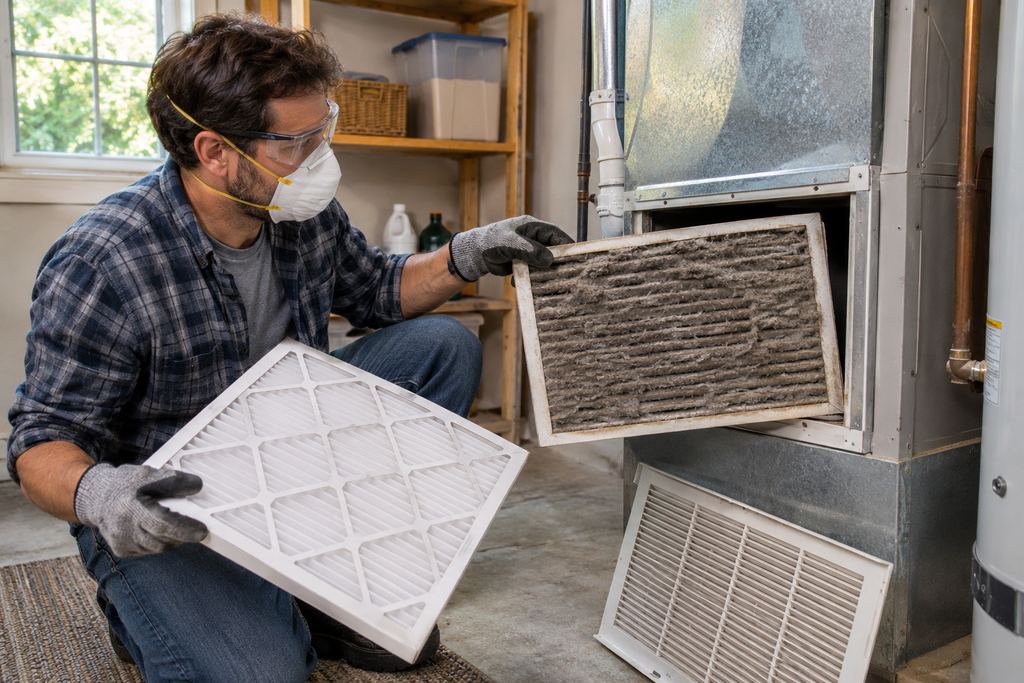
- Install a new furnace filter, since the AC uses the same blower
- Clear cottonwood fluff from the outside of the condenser by hand in June
- Wait for a genuinely warm day before the first run; many manuals advise against cooling on cool days
Leave these to a professional
Gas valves, burners, venting, refrigerant, capacitors and electrical circuits need a qualified, licensed technician.
- Checking capacitors and contactors after the idle months
- Measuring refrigerant charge (EPA Section 608 certification required)
- Clearing rodent nests from inside the cabinet
- Flushing the condensate line and testing the float switch
Checking a Minnesota contractor
- 1Which licenses do you hold?The Minnesota Department of Labor and Industry has an online license lookup, and cities such as Minneapolis and St. Paul set their own rules for mechanical work. Ask and verify.
- 2Will you pull a permit?Replacements generally need one. Repairs often do not.
- 3What is your trip fee, and does it change after hours?Prices vary by company and time of day.
- 4Is the estimate in writing?Parts, labor and refrigerant on separate lines.
State help with energy costs
Heat waves without AC
Minnesota heat waves are shorter than those farther south, but older homes with little insulation can get hot fast upstairs. Spend the hottest hours in the basement or a cooled public building, use fans with windows open at night, drink water and check on older relatives. Call 911 for confusion, fainting or a rapid pulse.
City pages: Minneapolis AC repair and St. Paul AC repair. More services are listed on the Minnesota locations page.
What happens with a request in Minnesota
- You enter a ZIP code and the service you need.
- You add contact details and a short description.
- A contractor who accepts the ZIP code contacts you to arrange a visit. When depends on their schedule.
- You compare what you are told and any written estimate. You do not have to hire anyone.
General guides that apply in Minnesota
Minnesota cities
Only cities with a published page are listed. The list grows as pages are approved.
Questions
Does an HVAC company fix air conditioning?
Yes. Air conditioning is the AC in HVAC, and residential HVAC companies in Minnesota usually service furnaces and air conditioners alike.
Does Minnesota have a program to help pay for a new furnace?
Eligible homeowners can apply through the Energy Assistance Program, whose Energy Related Repairs can cover furnace repair or replacement. The Weatherization Assistance Program may also help. Start with your county's EAP provider or the Department of Commerce.
When is a good month to buy a furnace in Minnesota?
Late spring and late summer are slower for heating contractors, and you avoid shopping during a January breakdown. Compare written quotes either way.
Is my utility allowed to shut off heat in winter?
Minnesota's Cold Weather Rule, from October 1 to April 30, protects households that set up and keep a payment plan with their utility. Contact the utility to arrange one.
What are the top HVAC companies in the USA?
We do not rank companies. For a repair, what matters is a local contractor with the right license, a written estimate and parts for your equipment.