Furnace Repair in Cleveland
Furnace repair in Cleveland gets urgent fast, because a January night off Lake Erie can drop a house below 50 degrees in hours. Check safety first, then the few things you can look at yourself, then send a request so a local contractor who covers your ZIP code can diagnose the furnace.
Leave the building first
A gas smell is not a repair request. Stop here and do this now:
A carbon monoxide alarm is not a repair request. Stop here and do this now:
- Get everyone out of the house, pets too, and leave the door open behind you.
- Do not switch lights, appliances or the thermostat on or off, and do not use a lighter, a match or a phone inside.
- From outside, call your gas utility's emergency line or 911.
- Stay outside until the utility or the fire department says it is safe to go back in.
After the home is cleared, a licensed technician can check the furnace, boiler or water heater. You can come back to this form then.
Nothing was sent. This form does not handle gas or carbon monoxide emergencies.
Sending your request
Please keep this page open. The form is locked so the request is not sent twice.
Your request was received
We passed it to a contractor in your area. If one accepts, they contact you using the phone number or email you gave. We cannot say how soon, and you are not required to hire anyone.
No reply after a few days? Check your spam folder, then use the contact page.
We could not send your request
Nothing was sent to a contractor. Your answers are still on this page. Try again in a moment.Online requests are not connected yet
The request form is not linked to a contractor network yet. Nothing you typed was sent or saved. Please call instead, or try again later.Short answer
Gas smell or CO alarm: get out and call from outside. No heat with no warning signs: check the thermostat, the furnace switch, the filter and any outside vent pipes for snow, then request a diagnosis.
What happens with a request in Cleveland
- You enter a ZIP code and the service you need.
- You add contact details and a short description.
- A contractor who accepts the ZIP code contacts you to arrange a visit. When depends on their schedule.
- You compare what you are told and any written estimate. You do not have to hire anyone.
Stop here if you smell gas or a CO alarm sounds
- 1Leave without touching switchesSkip light switches, thermostats, phones and anything with a flame while inside.
- 2Call from outsideUse the gas utility's emergency number (many Cleveland homes are served by Enbridge Gas Ohio, formerly Dominion Energy Ohio; check your bill) or call 911.
- 3CO alarm or symptomsHeadache, dizziness, nausea or several people feeling ill at once: get everyone into fresh air and call 911. The alarm stays on until responders say otherwise.
- 4Wait for the all-clearRepair questions come after the utility or fire department says the house is safe.
If the house is getting cold
Cleveland snow and the high-efficiency furnace
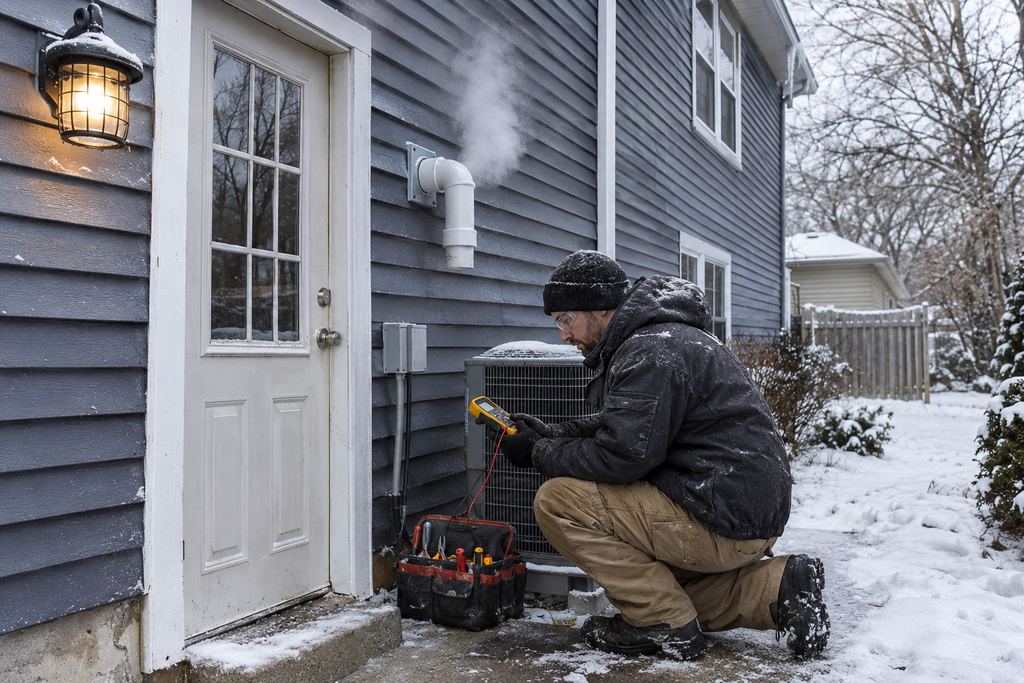
Cleveland's east side and the eastern suburbs sit in the lake-effect snowbelt, and drifts there pile up against houses quickly. Many furnaces installed in the last twenty years are high-efficiency models that vent through two white PVC pipes on a side wall instead of a chimney. When snow or ice blocks those pipes, the furnace senses it and shuts itself off, often with a blinking light on the control board. That is a safety feature doing its job.
You can safely clear snow away from the outside of those pipes with a broom or by hand. Do not reach into the pipes or remove anything, and if the furnace does not restart on its own after the pipes are clear, call for service. Condensate from the same furnaces can freeze in lines that run through an unheated garage or crawl space, which also causes a shutdown.
Older Cleveland homes add their own mix. Some still heat with a steam or hot-water boiler and radiators; for those, the boiler repair guide is the better starting point. Others have a converted gravity furnace or a basement unit that has been replaced several times, with ductwork that never changed.
Checks that are safe to do
- ThermostatSet to Heat, raise the setpoint a few degrees, replace batteries if the screen is faint or blank.
- Furnace switch and breakerThe switch near the furnace should be on. Reset a tripped breaker once; if it trips again, leave it and call.
- FilterA clogged filter can make the furnace overheat and shut off on its limit switch. Replace it if it is dirty.
- Burner doorThe front panel has to be latched in place for the blower and burners to run.
- Vent pipes outsideClear snow from around the white PVC pipes on the side wall. Do not pull anything out of them.
- Water at the baseIf there is water near the furnace, shut power off at the switch or breaker before touching anything near wiring.
What happens on a furnace repair visit
- STEP 1Symptoms and historyThe technician asks what you noticed and may read any blinking code on the control board.
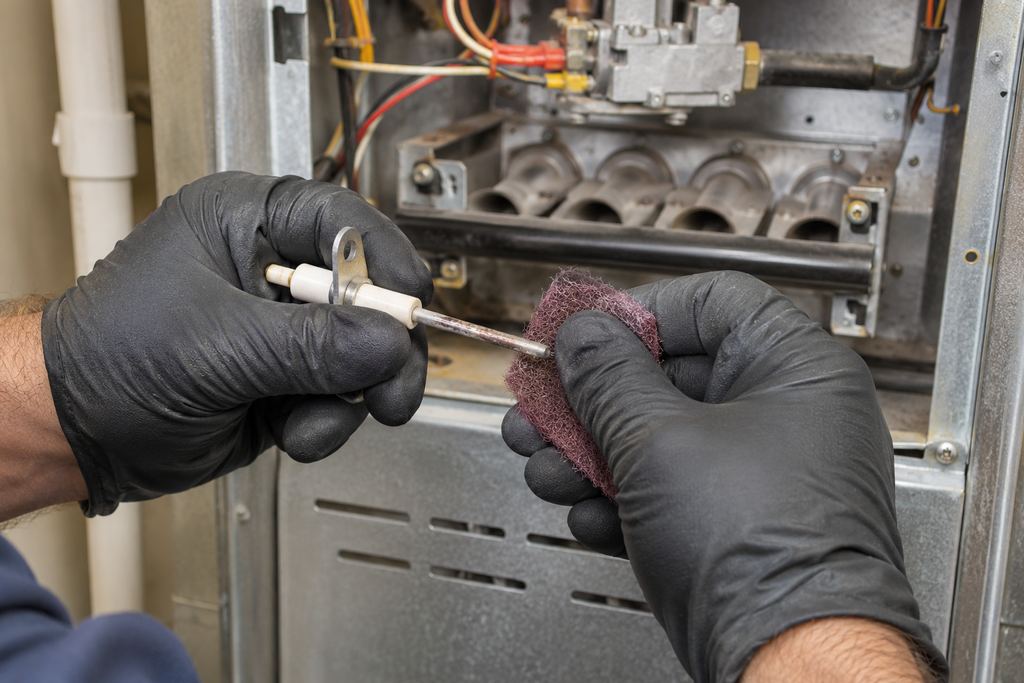
- STEP 2Ignition sequenceThey watch the furnace try to start: inducer motor, pressure switch, igniter, flame, flame sensor, blower.
- STEP 3Safety checksLimit and rollout switches, draft and venting, and gas pressure are checked. These are technician tasks only.
- STEP 4Diagnosis and written priceYou should hear what failed, why, and what the repair costs before work starts.
- STEP 5Repair and test runAfter the part is replaced, the furnace should run through a full cycle while the technician watches.
Common furnace repairs in Cleveland homes
Many no-heat calls come down to a handful of parts, though only the technician can say which one failed in your furnace. Dirty flame sensors make the burners light and then drop out after a few seconds. Hot surface igniters crack with age and leave the furnace clicking with no flame; the ignitor replacement guide explains that job. Inducer motors and pressure switches are frequent failures on high-efficiency units, partly because of the venting issues above. Blower motors and capacitors wear out on furnaces that also move air for central AC all summer. Control boards fail less often but cost more and may need to be ordered.
Ask whether the part is in stock. Brand-specific boards and motors can take days to arrive in a cold snap, and the technician may be able to tell you whether a temporary repair is possible in the meantime.
Repair or replace an older furnace
There is no fixed age at which a furnace must go. A well-kept 25-year-old furnace can still run, but parts get harder to find, efficiency is usually far below a new unit, and the heat exchanger has had decades of heating and cooling. Ask the technician to note the age, the repair price, the efficiency of the current furnace and any safety findings in writing.
A cracked heat exchanger is the case where the answer often changes. It can only be confirmed by a technician's inspection, and it is a safety issue because it can let combustion gases into the air stream. Replacing the exchanger alone is sometimes covered by a manufacturer warranty on newer furnaces, but labor is usually extra and on an older unit the cost often approaches a new furnace. Get a second opinion if you are told the exchanger is cracked and you did not see the evidence. For typical price drivers, read the furnace repair cost guide.
Before you agree to the work
- 1What exactly failed, and can you show me?A photo of a cracked igniter or a meter reading is reasonable to ask for.
- 2What is the diagnostic fee and the total repair price?Get both in writing.
- 3Do you charge more for nights, weekends or holidays?Rates differ by company, and some do not run calls at night at all.
- 4Who issues your license or registration?Ohio's Construction Industry Licensing Board handles commercial HVAC licenses; Cleveland and its suburbs register residential contractors locally. Ask, then verify.
- 5Is there a warranty on the part and the labor?Ask how long each lasts and what voids it.
Maintenance that prevents a mid-winter call
A fall tune-up gives the technician a chance to clean the flame sensor, check the igniter, test safety switches and look at the venting before the first cold week. Between visits, change the filter on the schedule your filter type calls for, keep the area around the furnace clear of storage, and test your carbon monoxide alarms. If you also have central air, the Cleveland AC repair page covers the cooling side, and HVAC repair in Cleveland handles calls where you are not sure which part is at fault.
Furnace repair in nearby cities
Only cities with a published page for this service.
Questions
How much do furnace repairs cost?
The price depends on the part, how long the job takes, whether the part must be ordered and whether the visit is after hours. A flame sensor cleaning and a control board replacement sit at opposite ends. Ask for the diagnostic fee up front and a written repair price before work begins.
Should a 25 year old furnace be replaced?
Not automatically. Age is one factor along with repair cost, efficiency, how hard parts are to get and safety. Many owners of furnaces that old ask for a replacement quote at the same time as the repair quote so they can compare.
Is it worth replacing a furnace heat exchanger?
Sometimes, mainly on a newer furnace where the part is under warranty. On an older furnace the labor and part cost can be close to a new unit. Only a technician can confirm a crack, and a furnace with a confirmed crack should not be run.
What is the $5000 rule for furnace?
An informal rule of thumb: furnace age multiplied by the repair price. If the result is above 5,000, replacement may be worth considering. It leaves out efficiency, safety and your plans for the house, so use it only to start the conversation.
My furnace keeps shutting off during snowstorms. Why?
On high-efficiency furnaces, blocked intake or exhaust pipes are a common reason, but a dirty flame sensor, a failing pressure switch or a frozen condensate line can do it too. Clear snow from the outside pipes, and if it keeps happening, see furnace keeps shutting off and request a diagnosis.