Furnace Repair in Cincinnati, Ohio
Most furnaces can be repaired, and in Cincinnati most furnace repair calls come in during the first cold weeks of the season and on the coldest January nights. Start with safety, try the simple checks, then send a request with your ZIP code. This guide also covers what contractors repair, what drives the cost, and when replacement deserves a look.
Leave the building first
A gas smell is not a repair request. Stop here and do this now:
A carbon monoxide alarm is not a repair request. Stop here and do this now:
- Get everyone out of the house, pets too, and leave the door open behind you.
- Do not switch lights, appliances or the thermostat on or off, and do not use a lighter, a match or a phone inside.
- From outside, call your gas utility's emergency line or 911.
- Stay outside until the utility or the fire department says it is safe to go back in.
After the home is cleared, a licensed technician can check the furnace, boiler or water heater. You can come back to this form then.
Nothing was sent. This form does not handle gas or carbon monoxide emergencies.
Sending your request
Please keep this page open. The form is locked so the request is not sent twice.
Your request was received
We passed it to a contractor in your area. If one accepts, they contact you using the phone number or email you gave. We cannot say how soon, and you are not required to hire anyone.
No reply after a few days? Check your spam folder, then use the contact page.
We could not send your request
Nothing was sent to a contractor. Your answers are still on this page. Try again in a moment.Online requests are not connected yet
The request form is not linked to a contractor network yet. Nothing you typed was sent or saved. Please call instead, or try again later.What happens with a request in Cincinnati
- You enter a ZIP code and the service you need.
- You add contact details and a short description.
- A contractor who accepts the ZIP code contacts you to arrange a visit. When depends on their schedule.
- You compare what you are told and any written estimate. You do not have to hire anyone.
Gas or carbon monoxide: leave first
Checks you can do
- ThermostatHeat mode, setpoint above room temperature, batteries.
- Furnace switch and breakerLook for a light-style switch near the furnace. Reset a tripped breaker once.
- FilterReplace if clogged; overheating trips the limit switch.
- Blower doorSeated firmly so the safety switch closes.
- Vents outsideHigh-efficiency furnaces vent through plastic pipes. Clear snow or leaves at the openings.
- Status lightNote the blink pattern for the technician.
Furnaces in Cincinnati homes
Cincinnati winters are milder than Cleveland's but still bring weeks below freezing, snow and occasional single-digit nights. Gas forced-air furnaces are the most common heat, usually in the basement. The city's older housing, brick homes on hillsides, row-style houses near the core and early suburbs, often has a furnace that has been replaced two or three times in the same spot, sometimes still venting into a masonry chimney. Some older homes run hot-water boilers with radiators; for those, see the boiler repair guide. Newer suburbs in Hamilton County and beyond have condensing furnaces that vent through plastic pipe, and some homes use heat pumps with a furnace as backup.
Requests are matched by ZIP code, so whether a contractor covers your address depends on who accepts requests there. Enter it in the form to check. Other local guides are on the Cincinnati page.
What Cincinnati furnace contractors repair
- No ignitionHot surface ignitors, spark igniters, older pilot assemblies and the control board.
- Short cyclesFlame sensors, limit switches, airflow and venting.
- Draft problemsInducer motors and pressure switches, chimney liners and vent blockages.
- No airflowBlower motors, capacitors and belts on older units.
- Water around the furnaceCondensate traps, drain lines and pumps on high-efficiency models.
- SafetyGas valve service, combustion testing and heat exchanger inspection.
What determines the cost
This site does not set prices or publish a Cincinnati average. For national estimates from published sources, open the furnace repair cost guide.
Cracked heat exchangers: what to know
The heat exchanger keeps combustion gases separate from the air your blower sends through the house. A crack can let those gases mix in, which is why a technician who finds one will usually shut the furnace down. Only a technician can confirm a crack, through visual inspection, a camera or combustion testing. If you are told your heat exchanger is cracked, ask to see the evidence and consider a second opinion.
Is it worth replacing just the heat exchanger? Sometimes, on a newer furnace still under the maker's heat exchanger warranty, where the part is covered and only labor is charged. On an older furnace out of warranty, the part plus labor often costs enough that replacing the whole furnace makes more sense. Ask for both prices.
Repair or replace
- Age: ENERGY STAR suggests weighing replacement when a furnace is past about 15 years.
- Safety: a confirmed cracked heat exchanger or venting problem changes the math.
- Repair size: small parts are almost always worth fixing; major parts on an old furnace often are not.
- Efficiency: a modern condensing furnace uses less gas than an older non-condensing one.
- The informal "$5,000 rule": age times repair cost, with anything over 5,000 suggesting a replacement quote. Nobody enforces it; it is a shortcut.
If you replace, ask for a load calculation (ACCA Manual J), how the new furnace will vent and drain, and whether the permit is included. If your AC coil sits on the furnace, ask whether it fits the new one; for the cooling side see Cincinnati AC repair.
What happens on a furnace service call
- STEP 1The historyThe technician asks what the furnace did, when it started, and what you already checked. Mention the blink code if you saw one.
- STEP 2Safety firstExpect checks of gas pressure, venting and draft, and often a carbon monoxide reading at the furnace and in the house.
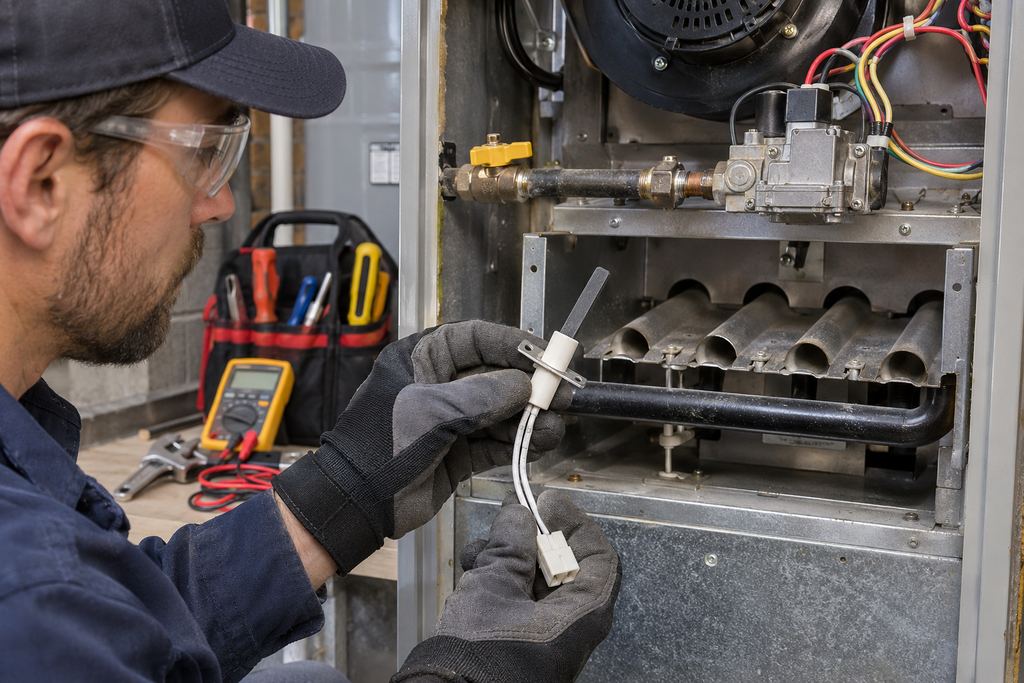
- STEP 3The ignition sequenceThey watch the furnace start: inducer, pressure switch, ignitor, flame, flame sensing, blower. Where the sequence stops narrows down the fault.
- STEP 4Tests on the suspect partMeter readings on sensors, switches and motors, so the part is confirmed before it is replaced.
- STEP 5Explanation and priceYou get the finding and a written price. You can approve, decline or get a second opinion; the diagnostic fee is usually owed either way.
Keeping a Cincinnati furnace out of trouble
A fall tune-up before the first cold snap catches many no-heat calls early. It usually includes cleaning the flame sensor, checking the ignitor, burners, inducer, blower and drain, and testing for carbon monoxide. Between visits:
- Change the filter on schedule, more often if you have pets or ongoing work in the house.
- Keep storage, laundry and paint cans away from a basement furnace; it needs air to burn safely.
- Clear leaves and snow from outdoor vent pipes.
- Test CO alarms on every level and near bedrooms.
- Watch for water around a high-efficiency furnace, which often means a drain or pump issue before it becomes a shutdown.
If your home has a heat pump with a gas furnace as backup, the furnace runs only on the coldest days, so problems may hide until a hard freeze. Testing the heat in October, before you need it, gives you time to schedule a repair at regular rates.
Checking a Cincinnati contractor
- 1LicenseLook for a license from the Ohio Construction Industry Licensing Board, the state body for HVAC contractors, plus any local registration your city or township requires.
- 2InsuranceAsk for proof of liability coverage.
- 3Written diagnosis and priceBefore work begins, with photos for any safety finding.
- 4BrandsMost contractors service all major brands. Ask how quickly they can get parts for yours.
- 5After-hoursWhether they handle night and weekend calls and the rate.
No heat, cold weather, help with bills
Furnace repair in nearby cities
Only cities with a published page for this service.
Questions
Can my Cincinnati furnace be repaired, or is it done?
Most furnace problems are repairable: sensors, ignitors, motors, switches and drains. Replacement comes up with a confirmed cracked heat exchanger, an old furnace needing a major part, or repeated failures.
What is the $5,000 rule for furnaces?
An informal rule: multiply the furnace's age by the repair cost. Over 5,000, compare with a replacement quote. It ignores safety findings and efficiency, so use it as a rough check.
Is it worth replacing a furnace heat exchanger?
It can be, on a younger furnace whose heat exchanger is still under the maker's warranty. On an older furnace, a new furnace is often the better value. Ask for both prices in writing.
Why does my furnace blow cold air?
The blower may be running while the burners are off for a reason: a dirty flame sensor, ignition problem, overheating or a fan setting of On. See furnace blowing cold air.
The furnace runs, but the house never gets warm. What could it be?
Possibilities include a clogged filter, closed or blocked registers, leaking or disconnected ducts in the basement or attic, a blower problem, or a furnace that is too small for the coldest nights. A technician can measure the temperature rise across the furnace to tell whether it is producing the heat it should.
Can I get a furnace looked at on a weekend in Cincinnati?
Some companies take weekend and evening calls, usually at a higher rate, and some do not. Ask the contractor who responds to your request what they offer and what it costs.
Do I need to be home for the visit?
Usually yes, or someone who can let the technician into the basement and approve the repair price. Clear a path to the furnace and the breaker panel before they arrive.
Should my furnace smell when it first comes on?
A brief dusty smell on the first cold day is common as dust burns off the heat exchanger. A burning plastic or electrical odor, or any smell that lingers, means turn it off and have it checked. A rotten-egg smell means leave the house and call from outside.
Where can I find more Cincinnati and Ohio guides?
Try Cincinnati HVAC repair for mixed problems and the Ohio page for statewide help.